All posts by reganbarsdell

88 Days

Manuscript

One of the world’s greatest forces is a sense of direction. My best days are often the ones that start with me being dragged from the sleepy tendrils of my dreams by a sense of purpose. And so one of the most satisfying things I can do for myself, is to ensure I set goals.

Around five years ago, I woke to a cold morning in Cambridgeshire. I crept downstairs and slipped outside, drawing boots onto my feet, and a hat over my head. I walked to a set of allotment gardens at the end of the street. There I watched the sun crawl into the sky, lighting frosted leaves, coaxing steam from shed roofs. I made a promise before the small, neat rows of vegetables, to write.

I have produced several hundred thousand words since that sunrise over Huntingdon. Articles, stories, a manuscript. A religious text. But most of them are still hidden away. Unseen. Untested. Unjudged. I’ve probably published 5%.

Today I am setting myself a challenge. I am allotting myself 88 days in which to confront my fears around sharing my work. I’m creating a list of tasks: interviewing a hero, getting a short story published, showing the world passages from my first book.

I’ll investigate the opportunities avaibale for writers in a digital world. I’ll look into ways  I can market myself, and the places I can go for help. I’ll introduce the people and services that assist me along the way.

And each week I’ll nominate a new inspiration, someone who I hope will help me learn something new. Maybe it’ll be Gordon Ramsey, or Tim Burton, or Katey Perry. Whoever or whatever it is, they’ll be my Muse of the Week, an excuse to look at things from a new perspective.

I’ll write all about it here. The good bits, the sketchy bits, the triumphs and challenges. Soon I’ll introduce my first muse.

So. 88 days. Starting…now.


Tools for being human, part seven: Eclecticism

beer

I once sat between two huge men in a seedy Budapest bar, hoping my mate Paul wasn’t being drowned by their companions in some dark stretch of the Danube. One of us (I don’t think either of us remembers/admits whose idea it was) told the other “let’s get a cab to the seediest pub in the city”, and there I sat, dripping with sweat and regret. It was a situation which taught me several things. That I can trust Paul in a sticky situation. That if you’re unable to pay a debt to the Hungarian Mafia, then you get pimped out in live sex shows. And that my desire to experience more of life occasionally threatens to shorten it.

The other significant understanding that hindsight offers, is that my willingness to engage with as many different ideas, experiences and people as possible, builds the parts of me I’m most proud of. I believe there is a cost in denying myself an opportunity to try something out. The price is ignorance, reduced opportunities. And most disappointing of all, it means fewer chances to overlap with other people.

It frustrates me when people reject things without strong reasoning. “I don’t dance, I don’t read anything by female authors, I’ll never watch anything made by Disney.” It upsets me when I realise I’ve rejected something from a place of ignorance, from prejudice. Short-cut thinking is something I battle against, mental laziness. And sometimes it really is a battle. It is easy to maintain a huge list of ideas with a yes/no indicator next to them. Do I give a shit about dinosaurs? No. Do I care about someone else’s faith? No. But I find it is then very difficult to undo these binary indicators.

Instead though, I can leave a space next to anything that I haven’t tried. Am I going to be impressed by walking in the footprints of dinosaurs in Colorado? Blank space. I’m far more likely to convince myself to give something a try, if my mind isn’t already saying “not interested”. And once I’ve built a history of saying “Cool, I’m up for it”, then the momentum of previous exciting experiences builds, and it generates FOMO as a by-product. And the Fear Of Missing Out, is a great counter-balance to niggling anxieties about exposure to shame, embarrassment, or naked flames.

I’d like to congratulate my family for their contribution to this mental attitude. I grew up with two siblings, and though we all shared a love of hair metal and bourbon, we also developed independent ideas of what constituted a good time. For example my brother was the martial arts one, and my sister the horse riding one. And growing up with them meant I watched them find grins and LOLs in places I hadn’t been. And eventually I guess it was FOMO again, which led me to dabble in their respective arts. So one day I trained in Japanese sword fighting, which led to my involvement in the Lord of the Rings films. And another time I began taking riding lessons, which has led to trots amongst the fairy chimneys of Cappadocia, tolts through the snow on Icelandic horses, and limb-ducking gallops across Czech forests. Oh, and several friendships, and a marriage.

My Dad didn’t do anything to counter my desire for diverse experiences. First, library visits with him meant I found joy in reading science fiction, Aesop’s fables, and to a lesser degree the ingredients on a can of toilet spray while I wait for difficult movements. This led to a (at this stage embryonic) career in writing, an inescapable interest in foreign lands and people, and a solid knowledge of non-CFC propellant mechanisms. Dad also had a strong desire to be his own boss, twinned with a low tolerance for boredom. So his decision to wear many different hats (firman’s helmet, chef’s toque, SCUBA mask) contributed to the ease with which I visualised myself as a chainsaw sculptor.

And then my wonderful Mum, she trained as a nurse, she worked with special needs kids, and then she led her and my Dad into a career in the wine industry when she decided to train in viticulture. So yip, I blame her for my weakness around an open bottle of wine, but also for my compassion, and that one time I worked as an art tutor with vulnerable communities.

So I have my family to thank for one of my greatest super-powers. And one of the greatest benefits of this power, is that it helps counteract a natural shyness. My readiness to consider almost anything has resulted in an interest in almost everything. I find that in general, when I meet someone new, I can usually find areas of commonality. Of overlap. This isn’t necessarily a shared experience or expertise, but if I haven’t told myself I don’t give a shit about laser holograms, then each time I encounter something around them, I build a little understanding. I write something other than “NO” in that blank box. And so when I meet an old Canadian scientist in a mead-dealing pub in Cesky Krumlov, we share an evening of stories, laughter, and herbed honey wines.

Common ground is a wonderful place for two people to start building a conversation, or mutual respect, or a plan to spend more time together. It doesn’t matter that I’m a Kiwi of no fixed career, and she’s a world class Brazilian surfer, my ability to find joy in more things rather than less, means that I’m more likely to be as interested in her side of the conversation as my own.

I’m far from perfect. There are plenty of things that I reacted against with minimal information. But I didn’t write “NO!” in the boxes next to Drum and Bass, or Trailer parks, or Bluegrass, and so when I eventually tried them, I discovered some of my most transcendent escapades. So I’ll push myself to maintain an open mind on as much as life as possible, because each new experience is a teacher, and each teacher guides me from places of ignorance, towards greater communion, towards stronger friendships, and towards being a more capable human.

Tools for being human, part six: Spending time in other people’s shoes

other-people

Before I started to travel, I thought the most inspirational experiences on the road would be those that belonged in an adventure film. Exploring intricate temples by torch-light, fighting imaginary foes on castle walls, passionate kisses on broken towers in front of rich sunsets. My first morning in Kuala Lumpur taught me that there was more to life than moments.

I woke early that day, a combination of time zones and excitement. I drew myself into thin clothing and stepped bleary-eyed into the dawn. I rose my hand over my eyes and admired the strong, early light painting a crumbling wall stone-fruit colours. I turned to look for shade and noticed an old woman shelling prawns on a step before a dark doorway. Our introduction was nods and smiles, and I stepped a little closer to look into her steel bowl. She tipped her head to the side as I made admiring noises, then held up a finger. She drew herself upward and then disappeared briefly through the doorway. She returned and passed me a second, smaller bowl, and nodded at the step. I sat down and she nudged the bucket between us. She showed me how to peel and de-vein with nimble movements, and then we sat, side-by-side, and watched the world wake.

She nodded to delivery men, she scolded children, and she kept an eye on my amateur efforts. She explained my presence to friends with shrugs of her shoulders, and they smiled in sympathy. And as the bucket slowly emptied, I imagined our spirits trading places, that it would be her that stood and brushed her hands on her thighs and walked out to find the tourist markets, and me that nodded gently and continued to shell prawns, rocking gently on the doorstep. And it was there, half-way through my second bowl, that I began a more important journey.

I once stopped over in Vancouver for a week, unsure what to expect. The first morning was cool and crisp, and I drew my beanie down over my ears as I walked towards the waterfront. I slowed to watch a young woman talking to her dog and rubbing its long ears. The two of them were curled under old blankets, beside steaming steel grates. I pretended to search through my bag for something, giving myself to observe without causing anxiety. I couldn’t get her out of my head as I continued down the streets, towards the super yachts and tourist float planes. What was the last thing she said to her parents? Did she befriend the dog here, in the city? The next day she was there again. And the next. I walked the same street each morning, hesitant to come too close, but curious for her story, for some understanding of the smiles she shared with her brindle hound.

On my final day in the city I bought a coffee, a hot chocolate, and some dog biscuits. I approached the lamppost which marked her spot with a mix of trepidation and excitement. I squinted into the sun as I approached the steam vent but there was no silhouette. Her spot was vacant. I was struggling with my backpack and hot drinks, so I awkwardly repositioned myself, arrayed my burdens around the lamppost and sat on my pack. I sat there in the sun’s glare, comfy in my three layers of jackets, sipping at the hot coffee. As I pushed the first empty cup aside a pedestrian glanced down at the cup and then to my eyes, and I shivered under their gaze. I was there for an hour with her ghosts, rubbing my hands and trying to guess her name. And wondering where or who I might be, if I’d lived through her days.

When I walk amongst the native forests in New Zealand, the birds are quiet. If I slow, then stop and lean gently against a giant Kauri tree, and close my eyes, I become accepted. The birds begin to pass messages on once more, and I become part of the bush. In the first days in a new neighbourhood I am an observer. I listen to the way people greet one another, the “good mornings” and “I’m enchanted”s. I swap nods with the old gents with hands clasped behind their backs. I find the streets where people sit and watch and wait for someone to ask how their week’s been. And gradually the gravity of communion draws me in, and I become a somewhat awkward part of the environment.

In the first weeks I’ve found good coffee (or began making it myself). I’ve hunted out the borscht made by the ex-mayor’s mother, and it may not be the best, but she speaks a little English and calls me ‘the lost one’ and introduces me to the regulars. I’ve found a piano shop where the students go to practice and dream, and on Thursdays a slim, dark browed man plays Crowded House songs with a gentle touch and his own version of the lyrics. Maybe I’m trying to understand the history of rebellion by hunting out ghosts and graffiti. I know what time the fresh custard tarts are drawn from the oven, and when to expect the rains.

After a year I am talking with new words and laughing at new ideas. I’ve found a job, or a way to live without one. I’ve found a new shirt, a new hat, and a pair of shoes that fits. When I walk through the dust and the mud I leave differently shaped footprints. I affect the economy, the gossip, even the scenery. And they affect me.

Taking these opportunities to dwell in places and situations far removed, it isn’t about the photographs, or the harvesting of stories. Ok, maybe a little, I’m a photographer, a writer. But more importantly it is the most effective method I know of for eroding my ignorance. Mornings sitting on a cool sidewalk, watching what was being delivered, peeled, stacked or washed. Watching how dogs and wives and spilt blood are treated. Standing in a queue at the post office, listening to the banter between builder and bailiff. Each step I take in another person’s shoes is a step towards a wider horizon.

Tools for being human, part five: Lego

lego-3I think the two most transformative toys of my childhood were my bike, and Lego. The bicycle might earn a place in this list at some stage, but today I want to talk about magical Danish bricks.

Five things Lego taught me about life

1. Lego taught me perseverance

The sound of my hand moving back and forth between one thousand plastic pieces in a wooden drawer. A pause as I draw up a helpful looking piece. The wrinkling of my brow as I realise it is too long, or too short. The feeling of the gentle-sharp bricks against my skin as I re-sift. The presence of a dozen four by four bricks when all you want is a six by four. Alanis Morissette would sympathise. The satisfaction as I finally roll a blue one-er between my fingers, all I need to complete the periscope on Captain Nemo’s submarine. Lego rewarded perseverance.

These days the hunts for a lost piece are over wider areas: Car keys, credit cards, camera chargers. As I try to remember where I left something, that old Lego drawer could be a metaphor for my ageing brain, my consciousness trawling back and forth between irrelevant information, trying to draw out the one piece I need. Maybe I should keep all those useful things in a wooden drawer. Good idea Lego.

2. Lego taught me competitive spirit (or perhaps selfishness)

The battles to the last part. My brother, sister and I combing frantically, harvesting wheels in the race to build the most powerful battle truck. Their younger eyes, my longer arms, I lean further and further over the drawer attempting to obscure their views. Lego and a shared pack of fish and chips were the two surest way to encourage my competitive edge as I hoarded blue bricks and hot chips with the watchfulness of a lioness and the selfishness of an elder brother. I don’t think I ever wished my siblings would disappear, but I did sometimes imagine how much more simple life would have been if they’d been born with little baby t-rex arms…

3. Lego left gaps for my imagination

A brick is a wall, is a building, is a spaceship blast-door. The most powerful thing about Lego was that it left space for my imagination. Jagged brick lines became a dragon’s tail, a pirate’s whip (everyone in my imagination had whips after Indiana Jones) or a breaking wave. Spit would fly as I added a juddering soundtrack of explosions, laser blasts or dragster wheels spinning. The joy really was in the neutrality of the bricks, they were simply a stepping off point to a story. The creators of Dr Who understood that dodgy props and costumes don’t matter, as long as you’ve engaged the viewer’s imagination.

4. Lego encouraged versatile thinking

Perhaps because Lego let me imagine I could build anything, it also encouraged me to think outside the bricks. At its core it was a building set, and it played well with others. It had hinge and hooks, holes and connectors. With a rubber band I could enable a catapult to fire, or make the world’s most delicate tank tracks. One of my friends got a Pez dispenser for his birthday. I eventually swallowed my envy and built one out of Lego. Ok, my fish bowl wasn’t so successful, but the epic flyovers us kids built for the slot car set were Californian in scale, if a little third world in execution.

Lego didn’t make me an overnight engineer, but I learned that if I didn’t have something, then I could make it. So I built medieval weapons in Granddad’s workshop, tea-stained treasure maps in the kitchen, and launched hand-crafted rubber-band powered planes with Dad on the driveway. I’m convinced that a childhood of making and crafting has contributed to my conviction that I can make do with less.

5. Lego was a hardening agent and a catalyst for curses

For every miracle of Scandinavian toy creation there is a dark side. Bare footed night-time walks to the bathroom were the best way to hunt out lost bricks. Actually maybe that’s just a spectacularly good design feature, no piece of Lego was ever lost for long. Lego prepared my feet for jerky barefoot walks down gravel paths, and jolting runs over hot black sands. Unfortunately it also earned me a few scoldings for the foul-mouthed language of discovery, but other people treading on misplaced bricks did help widen my cursive vocabulary. Very useful for blending in at Glaswegian festivals.

Still, I’d much rather run over a pit of hot coals than a blanket covered in those jagged-edged plastic shards. A blessing and a curse then.

Lego as guru

Dear Lego,

You taught me of Dependability and versatility. You were an aid to my story telling. You taught me never to get too attached to my creations, as the next day they would need to be demolished to make way for whatever came next. You tried to teach me that there was no such thing as perfection, that it was ok to have an all red sports car, except for one side of the bonnet. We had to agree to disagree there.

Thank you Lego, for the part you played in my own construction. And thank you Mum and Dad, for paying over the odds for a Danish toolkit for my imagination.

Much love,

x Regan

Tools for being Human, part four: Dancing

dance

I’ve always had a complicated relationship with dancing. I don’t think there is anything I’ve ever felt so embarrassed doing, so many times, yet still felt a compulsion to repeat. Not even skateboarding. But I’m writing about a hundred things that help me feel human, not a hundred things I’m really good at. And there are times that moving to the rhythm, has a power to lift me beyond troubles, over hurdles, and beyond the reach of apathy. But there are other times that I stand on the edge of the dance floor and something inside me won’t allow my soul release.

I think key to understanding my schizophrenic response to the tempo is to map my rhythm-enthusiasm against my self-confidence. On the courageous evenings when my assurance is firm, my rhythmic libido is freely exposed. On the darker nights of the soul, during those long hours in which I suspect I was placed on this earth as a lesson to others, there’s no way this fool should be on the d-floor. No one should have to bear witness to an uncommitted dancer.

I guess I should take time to understand how I came to this perplexing state. Maybe it is time for a little journey through my history with dance.

The Waltz

Ballroom dancing lessons. Who the feck decided the best way to prepare me for the real world was to force me into such a blush summoning, sweaty handed, gender-based Mexican stand-off? Thirty eight boys along one wall, thirty-nine girls along the other. Acne, quavering voices, levels of anxiety off the emotional Richter scale. Ok, ok, within all that terror and unrequited adrenaline there are slivers of excitement. The slow building drums of Fleetwood Mac’s “Tusk”, those few, thin moments in which a girl approaches me, just before hope gives way to suspicion she’s acting under the power of a dare.

But it was in these sessions that I learnt of the fragility of hope. And that my ego was equally delicate. And that people I barely knew had the ability to fracture either with a simple, uncaring rejection. Films and television had intimated that my first dance would a series of stuttering moments, mis-steps with a soundtrack of mutual giggles. My hand held gently against the fabric of the back of her dress, her eyes and mine sharing brief glances. Reality delivered a sweaty angst-fest that very nearly put me off The Dance forever. It is only in writing this that I realise hip hop might well have saved me.

The Backspin

This was it, the phenomenon that let me believe dancing might actually be a legit part of my existence. Break dancing had “cool” accessories: a slice of metre-square  linoleum, an aunty-crafted  set of purple MC Hammer pants, a hand decorated ghetto blaster. Practice sessions were held in friend’s garages, or their bedrooms, one of us trying to desperately to balance single-handed on a coke can, the other clapping encouragement. Encouragement!

Us white boys lived so far from the ghetto we get to dance to caterpillar to the Footloose soundtrack without fear of dance-related beatings. There were rumours that huge gangs of angry teens in New York settled issues with dance-offs, so in a distant-cousin kind of way we were by association gangster, fly, on the edge of something our parents couldn’t understand. Superhero moves, running up walls, flips, high-tops. And the robot. I’ll never forget the feeling of the clap circle as I twisted into the start of an epic windmill, only to collapse in giggles and be hauled to my feet by friends. The memories of enforced waltzes weren’t forgotten, but Grandmaster Flash gave dance a fighting chance.

The mosh pit

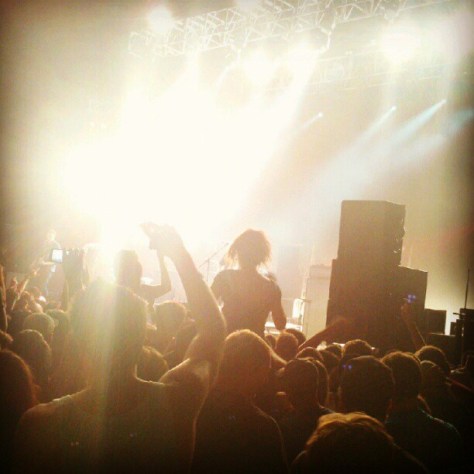
There’s dancing with partners, there’s dancing in the centre of the circle, and then there’s the mosh pit. It isn’t easy to describe the uneasy combination of high intensity thrashing and a pervasive awareness of each other’s well-being. As one person goes down, others draw them up. As I launch myself into a shoulder charge, I’m landing my shoulder into another, I’m inflicting only the gentlest of bruises as guitars wail and drums thunder.

The pit is an example of mob mentality with a positive modifier. As you’re drawn into the front-of-stage crowd you become a part of it. It exists as an outlet for expression through physicality, but for me it is also an opportunity to be physically one with others. The moves are barely articulate, pogoing, short runs, twists to free yourself of the centre, and ultimately stage dives. But for me it is a way to hold onto others amongst the music, to feel part of something that extends beyond my own body. And there is something unveiling in aiming to appear out of control, and yet being aware of every twisting spirit around me. Rebellion tempered with empathy. I think it’s that tension that I enjoy, and the feel of the arching floorboards throwing me higher than the beat.

The rave

The millennium, champagne, pills, lines, Vauxhall Bridge, Swedish twins DJing, my first crack at the turntables. My introduction to rave culture was a trial by toxicity, my guide an Australian chef. Within a few hours the music finds a place within me, rounds out my skull, trembles down my arms. The courtship of narcotics and tunes, the slow build, the breakbeat, the pause and release. Music that only makes sense when you dance it.

My relationship with drum and bass and garage and trance was brief and intense. Two, three years, chasing what in the dusk felt like humanity’s best chance for empathic union, and in the dawn felt like a plot to enslave a generation of addictive personalities. But there’s something about dancing towards the DJ, lasers lighting up smoke, water bottles in the air. Your focus is forward or inward. With no audience there’s less room for inhibition. Just you , the tunes and 5,000 megawatts of lasers.

And so…

Hmm, ok, there’s a lot of good times in there. If I also add in all the slow-foot reggae shuffles in the sun, the car seat boogies on long road trips, the Forbidden Dance, the silent discos, dance has given far more than it has taken. And I guess it has never really taken anything, rather I’ve just not been in a position to give.

In future I’ll try to use some of these other tools to ensure I’m more open to her charms. And to my own.

Tools for being human, part three: Understanding mortality

mortalityThere are dates within a year which tend to prompt self-reflection. My birthday, St Patricks Day, Hallowe’en. On these dates I usually find myself attempting an appraisal of my existence. I think of highlights and disappointments, of what has been present and what has been missing. I often then end up giving myself some sort of school teacher’s assessment. ‘Regan needs to find more productive activities on which to focus his energy.’ ‘Regan is prone to spending a little too much time day-dreaming in class.’ ‘Must try harder.’ And then there’s some sort of mental promise to myself to make changes.

I never thought to apply a score when I look at my life to date. I mean I can’t really look at it like an album or film review, I haven’t yet had a chance to enjoy the entire performance. But if I did have to rate myself, I can’t think of a time when I’d have given myself a perfect ten. Perhaps today I would give myself a seven. Recognition that there have been some standout achievements amongst the scattering of self-triggered disappointments. And as always, acknowledgement that there’s room for improvement. Up until quite recently though, I never really thought about whether there was time for improvement.

Death has always been an abstract idea for me. I thought occasionally about the final moments, the actual end point. Would I rather drown in a sea of lava or choke on a hotdog? Which Metallica song would I have play at my funeral? But not until I started losing people did I really understand that my time on earth is finite. I only have an unknowable number days left in which to train for a marathon, write a best-selling novel, and/or undo the psychic damage of mistakes I’ve made in the past. Lately though mortality has started to have an effect on my understanding of the world. I’m beginning to understand that my choices are made against a finite span of time.

And now I can see the that I might be able to utilise those times of deliberation and contemplation in order to make useful changes.  I can imagine two different personality-dependent approaches to ensuring that the rest of my life can be used to drag up my overall rating. If I imagine my life as a graph, a jagged chart of time versus enjoyment, with each upward spike a moment of joy, or kindness or ecstasy, and each downward dip a failure of morality, character or heart. If I want to use my remaining days above the ground to improve my overall score, I can look at affecting either the time-scale, or the enjoyment-scale.

If I was a certain type of person, I would concentrate on extending the time scale. I would make choices which I hoped would ensure I survived for long enough to achieve more happy spikes. Maybe I start to reduce my exposure to risks. Perhaps my next birthday would be a meal in a small restaurant, close to home, rather than two weeks in a war zone. I might take out insurance in order to protect myself from incidents. Rather than saving for airfares, I’d harbour money for my later years, protection against poverty. My New Year’s resolutions would be used to set restrictions and goals which promote durability over excitement. ‘Drink less’, ‘eat better’, ‘run more often’. You can probably tell from my tone that I’ve opted to take another path.

Rather than plotting to make it to my hundredth birthday I’d rather make the most of however many birthdays an active and varied life grants me. If my life is a book then I’d rather it was a mid-length thriller than a thousand-page health and safety manual. I’d rather take a few risks than avoid all of them. At the end of a year I’m more interested in promises to myself which excite me. ‘Visit a country that scares me’, ‘make my own surfing movie’, ‘learn enough French to say “Two beers please, my friend is paying”.

Of course there are issues with opting for a (potentially) shorter, brighter life. Most of the time I don’t have a Plan B. I go to the doctor when I’m in pain rather than when I want assurance. But the one really problematic side I see to my approach to life, is that there is a degree of selfishness implicit in focusing so much on my own desire to extract all I can from as many moments as possible.

My drive to see more of the world, to hear more from its people, necessitates that I’m rarely in one job or city or neighbourhood for very long. This means that my new friendships are frequently fleeting, that I don’t get a chance to warm them into something more permanent. There’s a melancholy there at times, when I see an update on Facebook from someone I once spent just a few days with. Someone I wish I could have engaged with more, offered more to, drawn more from. One thing experience has taught me is that people are always a component in my happiest moments. Someone to help gather wood for the fire, someone to play guitar while I sing, someone to high-five when I hang ten.

As I write this on the last day of 2016, consideration of my mortality helps me understand what I want from whatever remains of my life.  I’m not great at making promises to myself anymore. I’ve failed once too often at the ‘must eat less at Christmas time’ pledge. But tonight I’ll be thinking of the people who I’ve met, who have triggered curiosity, and wonder, and who have inspired me to be a better version of myself. And I’ll promise to try harder to reach one hand back towards old friends as I hold the other out towards new ones. Because although I don’t know how many days I have left in the world, I do know that I want as many of them as possible to be shared with those people who teach me to fly, rather than those who tell me it is too dangerous to try.

So to all those who shared smiles and laughs with in 2016, thank you. To all those I wish I’d had more time with, I’ll try harder in 2017. And to those who passed beyond my reach, I’ll look for you in the stars when I next dance under the blanket of night.

Tools for being human, part two: People watching

temple-woman-modifiedThe old man is initially defined by the curve of his spine. He’s bent almost double by some malady, and I feel the warm prickling of guilt as I watch him roll one sleeve up, and look over his shoulder. But I’m over the other shoulder, at a window seat in a busy cafe with another dozen pairs of averted eyes. He tilts his body like a crane and drapes his hairy arm over the bin. Then he draws something upward, a brown, moist-edged paper bag. He shakes his head as he parts the paper packaging, drops the disappointment back in the bin and draws a slow, visible breath as he wipes his fingers on his chest. I warm my fingers on my coffee cup as I wonder when he last saw the horizon, what his mother’s name was, on which shore he left the love of his life, in order to chase a dream he thought she’d never understand.

I lean back a little in my stool, and steal a glance at the young man seated next to me. He folds a page of his sketchbook over gently, rests it on the counter. He leans back on his seat to lift pens or pencils from his day pack, and the end of a tattoo on his neck is revealed. Just a spiral really, a couple of twisting grey lines, but enough to allow me to continue drawing them down, over his chest. A tentacle maybe, from a squid, wrapped about a tall ship. Perhaps his father was a fisherman, but this thin young man didn’t enjoy the drawing of fish to the deck, the stomp to the head, the curl of the sea against the roll of his stomach. But cancer took his old man three years ago, and the myth of their connection now wraps about his heart.

When I was young I couldn’t imagine a world occupied by uncountable billions of people. By the last year of high school I knew the faces if not the names, sometimes a story, what type of bike they rode, their sister’s horse’s name. Two months later I found myself at university, trying to understand how I could be amongst so many people and yet feel so, so lonely. On the third or fourth day of lectures I sat in the Mt Street Cemetery, wondering what my options were. As I watched the shadows thrown by the lowering sun, I noticed a woman in a long, dark dress, walking slowly down the hill, picking her way between tombstones. She wore her thick auburn hair in a loose bun, her feet were tied into tall leather boots, and her eyes were on the sky rather than the path. And I began to tell myself a story. She knew a mermaid once, or at least a trans-gender Greek man who professed to have been half salmon in a previous life. And before she moved here to study Philosophy she had dated a musician, and hopes that she was responsible for a line in one of his songs. And for her Wellington was a temporary home on the way to somewhere she dreams of, writes poems about, draws sketches of. Probably somewhere with windmills and moats and scarecrows. She eventually passed out of view, but I remembered her as I walked to class the next morning, and I kept an eye on the crowd, my eye focused on possibilities rather than disappointment.

Some years ago I sat with Linda in a crowded outdoor market in Singapore. At first we are the only two white people in a spiral of Asian humanity. But the longer we sit, sipping at cool fruit juices, the closer the spiral twists about us. A young boy is concentrating on unwrapping a balloon string from his hand, and suddenly his eye catches mine. I smile gently, his head tilts a little and he reflects the curl of my happiness. He turns to his mother and lifts his arms, looking up at the red bubble above. Was the balloon a bribe, a gift, a location-detector? And as I pick out the faces and forms in the crowd, I feel the place seep into me. The strong brown arms of a vendor tying a rope under his marquee, his glance across at a women in the stall opposite, his motion pausing for just a second. And that brief pause is another story. When I take time to consider others in a crowd as people, as lifetimes, as part of a bigger family, then loneliness doesn’t make as much sense. Nor do anxiety and mistrust.

So I have learnt to enjoy sitting still and watching others. And sometimes I wonder if my observations are two-sided. Am I in turn being watched? Does the old woman in dark glasses at the other end of the cafe counter see something in the way I pause between writing paragraphs? Does she wonder why my eyes are drawn to this person or that? Does she notice my glances are often to younger women, but that I quickly shift to other targets? Does she wonder if I am embarrassed to let my stare linger on those more obvious attractions? Or is she hoping I leave that half croissant on my plate, that she might gently gnaw its buttery sweetness once she draws it from her pocket in another hour?

And at other times I find myself considering the other counterpoint to my scrutiny, what do my observations say about me? Why do I presume that the beautiful, artfully dressed girl carries the awkward longboard merely as a prop, an unwieldy attempt to be a part of an alternative crowd? Is it my own pretences that are the seed of this judgement? Or simply jealousy of the gentle perfection of her features, the grace of her stride? What right do I have to be so silently outraged at the three couples staring into their phones, rather than into each other’s eyes? Am I really so fortunate to have experienced uncomfortable first-date silences in the Facebook-free millennium?

I feel there is something useful in imagining myself in someone else’s shoes, or burka, or domestic dispute. If I remind myself that others have their own choices to make, their own mothers to please, their own dreams to chase (or abandon), then acceptance of difference is not so difficult. If I try sitting inside their thoughts, imagining their troubles, then tolerance is not such a stretch. And I’ve found that over time I have built the self-confidence to bridge that gap between myself and the stranger. I find that empathy gives me the power to overwhelm by traditional shyness.

I finish my coffee, lower the cup and press a finger to the counter in front of the young man’s slow-forming sketch of a big-eyed woman. His first girlfriend? Or a character from a dark Japanese horror? ‘She’s beautiful’ I say, looking to his hesitant eyes, imagining his anxiety, but also the warmth of pride. I leave the half-eaten croissant on my plate, and slide it gently in the direction of the old woman as I sling my bag to my shoulders and shift toward the door. I can’t see the bent man, but if I walk to the bottom of Cuba Street, perhaps I’ll be able to offer a kind presence, or a tray of sushi.

I met the woman from the cemetery again in my second semester, and she invited me to a party, a celebration of the release of The Cure’s ‘Disintegration’ album. She went on to study in Germany, and to write prize-winning novels. She inspired me to try out black lipstick, read Edgar Allan Poe, and to use a thing called electronic mail to send fantastic stories to my fellow students when I should have been studying. And her success in story-telling inspires my writing today.

So I dedicate this piece to ‘Cath the Goth’, to my fellow people-watchers, and to all those I’ve watched and never quite had the nerve to smile at, or wave to, or buy a coffee for.

100 tools for being human. Part one: Fire

flaming-june

I was raised in a lands-end suburb that bordered on a children’s paradise of ponds and gullies and hills. Men took to those hills from time-to-time, built basic shelters, shat in the earth, and burnt food in stone-bound hollows. So as we kids roamed the goat tracks and stream beds we’d occasionally come across those blackened rocks, and breathe in the acrid scents of ash and loneliness. The marks of habitation, the shades of rough men with dark purpose. Or no purpose.

In those days (and hopefully still) Dads taught kids to criss-cross kindling atop tightly balled paper, to touch a flame to three different points, to wake the orange cinders with gentle breaths. And something would draw us back to those sites of burning hidden below the bus routes and parks. We’d shed our schoolbags as we entered the clearing, and imitated our ancestors crouched poses about the dark circle. One of us tears up a leaflet advertising a furniture sale, another breaks twigs, twists their wet strands, drops them in a small pyramid over the grayscale pictures of outdoor furniture and sun-umbrellas. The last holds one of three stolen matches over their worn-edged matchbox, rocking gently, eyes on the growing pile of kindling. There is ritual in the architecture of a fire, an act which might once have determined survival in lands our bodies were not evolved to inhabit.

We urchins exchange glances, there’s a nervousness around those moments before ignition. The last piece of wood is lowered, and two of us wriggle back a little, allowing the fire-starter space. Three matches, the first skips over the worn strike-pad, not a spark. The box is flipped, the match rotated, anxious fingers scrabble under watchful eyes. Another flick, the sound is rough but still no flash or flare. We other two ache to take up the task, our empathy is false, we feel frustration. Then a quicker flick and the match head is engulfed in a glow, and we are drawn to the scent of sulphur, the dance of the tiny flame. Cupped hands, scooped forms, the burning wooden sliver is lowered towards the curled newsprint.

Fire beckons something inside of me, something buried deep. Like seeing a pair of eyes in the dark, or listening to the first seconds of Michael Jackson’s ‘Beat It’. As I age I am coached to modify my behaviours, to bury some of my ideas and feelings under layers named ‘civilised’, and ‘mindful’, and ‘Health and Safety’. I am taught, both directly and indirectly, that we are not like other animals, that we should hold ourselves above the wolves, the bison, the apes. Fire reminds me of the lie of this. It excites me, the thrill of fear beneath the joy of feeling the warmth against the cold, watching the shadows dart about the walls. In its glow I am reminded the idea of safety is dependent on fear. And I think I am far more capable if I learn to handle dangers rather than avoid them. What sense is there in being alive, if I never really feel it anymore?

The sun is lowering in the sky as we dip lower, prodding at the low flames, blowing, wafting. The paper burns away quickly, the wet twigs smoulder a little, but the last flame ascends as smoke, and the matchbox is drawn up. The strike-pad is torn away, the box becomes part of the combustible stack. Impatience overpowers empathy and the next player draws up the tools of ignition. The next match is struck.

I find fire is a great conversational companion. It allows the eyes a distraction without demanding their attention. And it is sensuous. The shift of light defines us loosely, our form sketched rather than photographed. And we are allowed to be defined by the imagination as much as by reality. A meeting under flame is three times as likely to lead to intimacy. Probably. Some of my most evocative memories of the past are centred on bon-fired beaches, or fire pois, or a candle-lit stairway leading to a low couch, a bottle of wine, a hope for intimacy.

Us three young boys (at this age society has separated us from the girls, the horse riders, the hair-plaiters, the more capable minds), we work again with blowing and coaxing and wishing. We sacrifice a homework assignment drawn hurriedly from a leather satchel. The blue-printed questionnaire holds a long flame and our mouths form ‘O’s’ of wonder, and we pause for a second in the stretched yellow flickering. Then the paper is dropped and we shift twigs. And two of them catch, and white smoke begins to curl, lit up by the few spears of sunshine that penetrate the bush canopy.

Sometimes it is a radiant fire on a cooling beach, the lightest of winds drawing the smoke away from you (for now).  Someone picks at a guitar, or speaks words, ‘Once, a long time ago…’, and our minds are released to travel on a voyage, to draw the characters, the situations, the Gods and beasts and heroes. And beyond the reach of the flames there is room for the imagination to plant stories, and monsters, and mythology.

Other times there is just you alone, over a flame in an old pan, holding a photo, or an agreement, or a letter of rejection. You can delete an email, or the last contact from a lover, or the image of an unholy prophet. But how much more cathartic is it to hold a thick sheaf of paper above a flame, lowering just a little further, feeling the heat of the smoke curling over your knuckles. Then the thrill as the flame runs along the edge, leaving a blackening shadow.

The embers pulse gently, the three of us talk of a great journey for the next day, on bikes into the hills. Maybe the horsey girls will be there. One of us begins to stand, tucking the last match and slice of box into a pocket. Another of us sprinkles soil over the embers, hands hovering over the gentle warmth. Then the three of us shoulder bags and move up the hill. None of us can resist a last backward glance at the pit. A brief silence gives way again to plans and schemes and nudges and laughter.

A fire is infinite form. It is a destroyer and yet it is born before us, from spark and breath. Flames to hold back the beasts, extinguish the shadows, summon the Gods. It is to be respected, and anything which allows reminds us to be humble is to be treasured. Humanity isn’t at its best when it ranks itself above all else.

Losses and gains

Cognitive dissonance is a term for what happens when you experience something which upsets your understanding of how the world works. Like being told by the people you surround yourself with that a comet will destroy the world on October 12th, giving away all your worldly possessions, breaking ties with your  family and friends, and then waking up on October 13th to someone’s Beyoncé alarm.

As I climbed into a yellow cab outside JFK three weeks ago, I believed that Trump’s loss was inevitable. I believed this with the same depth of surety with which I’d once dismissed the Internet as ‘just a fad’. I was about to become very familiar with cognitive dissonance.

As I looked out the taxi window onto the streets of Queens I was also preparing myself to be lonely in a new city, to be ready for rejection on both sides. But despite my anxieties, New York City and I just…clicked. Within days we ended up giggling together, telling in-jokes and slamming Hennessey and Red Bulls in dive bars at 3:00am. I remember a moment, maybe a week before I flew out of New Zealand, when I read something about New York being a place that all sorts of dreamers headed, in order to birth their ideas. And that was it, I met so many people who had dreams, and talents, and self belief. And they talked with me. They shuffled along the bench and made room for my ass and my ideas. My imaginative soul had found a new home.

This all began well before election day. I had made what ended up being a very good decision to begin my exploration of the city from a Williamsburg base. From there I found great coffee, astounding vegan Reuben sandwiches, and hundreds of artisans practising intricate arts, from distilling to button-making. I found centres for Judaic thought, summer food-markets that looked out over Manhattan, and people who looked me in the eye when I explained who I wanted to be. And looking back on it, I realise that as much as that time was about New York charming me, it was also about me appealing to her.

It isn’t easy to explain, but I think it was about being open to anything. It was about starting the conversations, sitting at the bar rather than the booth, dancing on the rooftop rather than in my dreams. It was about expression and engagement. It was also about being comfortable and confident. I was surprised to find I was more comfortable in that city than anywhere else I’d ever travelled. I was frequently a racial minority of one, but most of my endearing moments were with people who had been labelled as minorities their whole lives. I was often lost, but I quickly built a trust that lost was a euphemism for ‘on the way to an unexpected experience.’

And then just as all was going so well, there was that election night. At around 4:00pm I stood on the corner of 46th and 9th Ave, debating which party to attend. A tall beggar in a thick coat asked me for a dollar for cawfee, and I declined. He began an explanation as to why I was making a poor choice. As he talked I noticed shapely sculptures outside an Irish bar, The Playwright. I gave him a ‘waddayagunnado?’ shrug and explained I had no change and I was meeting a friend. A friend called Bud. Who was apparently half-price between 4 and 6pm. Good timing Bud.

Half the screens above the bar showed sport, the other showed a mute countdown to the first voting results. I dragged a stool under myself and drank in the scene. There was a good mix of characterful faces, and there was a password for free wi-fi. So I ordered a beer, connected, and an hour out from the start of Trump’s ascendency I found out a young man I knew had taken his life. I looked about the thickening crowd, I looked down at my hand about the pint glass, and I looked back to the last times I heard from him. I swallowed back my beer then I noticed a woman next to me was drinking from two different glasses.

‘What are you drinking?’ I enquired, hoping for something more exotic than Budweiser.

‘Hennessey,’ she replied, ‘and Red Bull.’

And in that exchange I found a new friend. And even as I struggled to come to terms with a feelings of loss, either I or the universe found a way to balance some sort of scales. I’m not suggesting that a new friendship can offset such dreadful loss. No, it was simply my head trying to find a way to reconcile a fresh case of cognitive dissonance.

The next morning I said goodbye to Matt from Bow Bridge in Central Park. I think he would have appreciated the view, and my imagining characters from the film Highlander beside me, talking about the coming end of days. I looked to the water below, the layer of fallen leaves. Then I looked up to the skyline, to the sunshadow forms of skyscrapers, and the sun behind them. And although I felt lead in my centre, I also felt the lightness that acceptance in a strange and new place brings. And now I wish that somehow I’d been able to help Matt find that. Or whatever it was that he’d needed to make a different choice.

The days following the US election results have reminded me of the importance of finding our voices. Of telling stories, and of being actively, positively human. And so I am going to start a new set of writings in the coming weeks. I’m going to try to hunt out 100 tools for being human. From Eye Contact to Trees, from Hope to Lego, I’ll be exploring the things that help me maintain my positivity, my humanity, in what can be a difficult world if we let it. Because I need to ensure that I’m doing, rather than simply being. And because I want to be there for people, more effectively than I have been in the past.

Unbinding myself from my masculine story in order to grow

Women

Photo coutesy of the fantastic Roni Kay…

There have been two points so far, at which I have had to re-invent my novel. The first was when I realised that the central story wasn’t big enough, and I replaced a distinct vodka with a unique religion. The second rewrite became unavoidable when I realised that if half of my characters were going to be female, I had a lot to learn a lot more about what it means to be a woman.

That epiphany was the result of three awkward periods of self-discovery. I experienced the first of these after I managed to almost completely destroy a friendship with an adventurous and astounding woman, Elza, through my inability to understand her perspective. The two of us spent several months travelling together, and yet the whole time we also moved further apart. The silver lining to what was a dark cloud was that honesty on her part allowed for introspection on mine. I was at least able to learn a valuable, if emotionally expensive lesson.

The second flashlight to be shone on my gender naiveté was held by another inspirational woman, Linda. I’d always found ways to convince myself that there were no vast differences between men and women, that it was simply our individual experiences that led to misunderstandings. But Linda helped me see that as my own experiences had only ever been as a man, I had ended up with a strongly gendered bias to my thinking. Yes, I was a product of all the things that had happened to me, of my environment, of the people I’d spent time with. But it would have been impossible for a woman in similar circumstances to have the same experiences. Society’s attitudes towards gender trumped my hope that we weren’t so different as we all seemed to think. Shit.

Around this time I read a Margaret Atwood quote, which compounded my understanding:

“Men’s great fear is that women will laugh at them. Women’s great fear is that men will kill them”

I spent some time bouncing between the two sides of that quote, combating my defensiveness. Both Margaret and Linda had helped shift my perspective in a new direction.

The last twist to my viewpoint was a short, sharp one, encountered around half way through the film ‘Wild’. In the scene that challenged me, Cheryl Strayed is alone in the woods, and she’s approached by two hunters. My presumption at this point was that things were going to go dreadfully wrong, and I wanted to be anywhere but in the theatre, watching what I thought would happen next. It was my intense relief when the men didn’t attack her that shook me. For years I’ve tried to point out that the media’s to blame for other people’s heightened fears, but I have to accept that I’ve been shaped by the way ‘they’ portray the world as well. And if the media’s amplification of a history of men subjugating women has made me uncomfortable at the idea of a woman caught alone by two men in the wild, how much more fear must that idea hold for some women?

I spent a lot of long walks rattling around inside my head after that, trying to make sense of all this. I explored my past. To what degree had I sexualised past friendships? How many relationships had I destroyed through wilful ignorance? How many women had I scared through my actions, or words, or attitudes? It would have been easy to tie myself to my failures, to see myself as a bad person. But in my heart I believe that I am good, and that I am the engineer of my own future. So I decided I needed to stop digging a pit and start building a bridge. I resolved to do better, to be better.

The interesting thing about taking so long to write a novel, is that the rewrites can mirror your experiences. This rewrite of my story began with a look at my characters. One character was blind, and I’d spent a lot of time trying to write as a person without sight, as someone who draws the world inside her head. But two of my four central characters were female, how much consideration had I given their experiences as a women in determining their paths through the story? Not enough.

So I began to read more by female authors. I examined the great conversations of my past, how often was it a woman who kept me awake, offering me new ways to examine Christianity, or gun control, or Israelis? Or Batman?

And then I walked from one side of Spain to the other, usually in the company of astounding women. And through this time I began to rewrite my female characters, as women. My principal character is a man, but he had to change too, his motivations, his confrontations with himself, the impact of these women’s new decisions on his plans. In fact he really had to step the fuck up. To say much more would give away too much of the plot, but I know that when I write the foreword I will be thanking a number of influential ladies.

I don’t want to be an apologist for men, I don’t see much value in trying to explain what shaped my biases in the past. But I do want to say thank you to all the people, men or women, who have contributed to me being a better person today. Some of you managed to improve my world view in as little as 24 hours, astounding. I will always be to a degree the result of what surrounds me, so I’m making a promise to myself that I’ll continue to as often as possible surround myself with good people. And I make a promise to all of you, that I will do my best not to cause fear, or anxiety, and to try to put myself in your shoes.