Category Archives: Uncategorized

Losses and gains

Cognitive dissonance is a term for what happens when you experience something which upsets your understanding of how the world works. Like being told by the people you surround yourself with that a comet will destroy the world on October 12th, giving away all your worldly possessions, breaking ties with your  family and friends, and then waking up on October 13th to someone’s Beyoncé alarm.

As I climbed into a yellow cab outside JFK three weeks ago, I believed that Trump’s loss was inevitable. I believed this with the same depth of surety with which I’d once dismissed the Internet as ‘just a fad’. I was about to become very familiar with cognitive dissonance.

As I looked out the taxi window onto the streets of Queens I was also preparing myself to be lonely in a new city, to be ready for rejection on both sides. But despite my anxieties, New York City and I just…clicked. Within days we ended up giggling together, telling in-jokes and slamming Hennessey and Red Bulls in dive bars at 3:00am. I remember a moment, maybe a week before I flew out of New Zealand, when I read something about New York being a place that all sorts of dreamers headed, in order to birth their ideas. And that was it, I met so many people who had dreams, and talents, and self belief. And they talked with me. They shuffled along the bench and made room for my ass and my ideas. My imaginative soul had found a new home.

This all began well before election day. I had made what ended up being a very good decision to begin my exploration of the city from a Williamsburg base. From there I found great coffee, astounding vegan Reuben sandwiches, and hundreds of artisans practising intricate arts, from distilling to button-making. I found centres for Judaic thought, summer food-markets that looked out over Manhattan, and people who looked me in the eye when I explained who I wanted to be. And looking back on it, I realise that as much as that time was about New York charming me, it was also about me appealing to her.

It isn’t easy to explain, but I think it was about being open to anything. It was about starting the conversations, sitting at the bar rather than the booth, dancing on the rooftop rather than in my dreams. It was about expression and engagement. It was also about being comfortable and confident. I was surprised to find I was more comfortable in that city than anywhere else I’d ever travelled. I was frequently a racial minority of one, but most of my endearing moments were with people who had been labelled as minorities their whole lives. I was often lost, but I quickly built a trust that lost was a euphemism for ‘on the way to an unexpected experience.’

And then just as all was going so well, there was that election night. At around 4:00pm I stood on the corner of 46th and 9th Ave, debating which party to attend. A tall beggar in a thick coat asked me for a dollar for cawfee, and I declined. He began an explanation as to why I was making a poor choice. As he talked I noticed shapely sculptures outside an Irish bar, The Playwright. I gave him a ‘waddayagunnado?’ shrug and explained I had no change and I was meeting a friend. A friend called Bud. Who was apparently half-price between 4 and 6pm. Good timing Bud.

Half the screens above the bar showed sport, the other showed a mute countdown to the first voting results. I dragged a stool under myself and drank in the scene. There was a good mix of characterful faces, and there was a password for free wi-fi. So I ordered a beer, connected, and an hour out from the start of Trump’s ascendency I found out a young man I knew had taken his life. I looked about the thickening crowd, I looked down at my hand about the pint glass, and I looked back to the last times I heard from him. I swallowed back my beer then I noticed a woman next to me was drinking from two different glasses.

‘What are you drinking?’ I enquired, hoping for something more exotic than Budweiser.

‘Hennessey,’ she replied, ‘and Red Bull.’

And in that exchange I found a new friend. And even as I struggled to come to terms with a feelings of loss, either I or the universe found a way to balance some sort of scales. I’m not suggesting that a new friendship can offset such dreadful loss. No, it was simply my head trying to find a way to reconcile a fresh case of cognitive dissonance.

The next morning I said goodbye to Matt from Bow Bridge in Central Park. I think he would have appreciated the view, and my imagining characters from the film Highlander beside me, talking about the coming end of days. I looked to the water below, the layer of fallen leaves. Then I looked up to the skyline, to the sunshadow forms of skyscrapers, and the sun behind them. And although I felt lead in my centre, I also felt the lightness that acceptance in a strange and new place brings. And now I wish that somehow I’d been able to help Matt find that. Or whatever it was that he’d needed to make a different choice.

The days following the US election results have reminded me of the importance of finding our voices. Of telling stories, and of being actively, positively human. And so I am going to start a new set of writings in the coming weeks. I’m going to try to hunt out 100 tools for being human. From Eye Contact to Trees, from Hope to Lego, I’ll be exploring the things that help me maintain my positivity, my humanity, in what can be a difficult world if we let it. Because I need to ensure that I’m doing, rather than simply being. And because I want to be there for people, more effectively than I have been in the past.

Unbinding myself from my masculine story in order to grow

Women

Photo coutesy of the fantastic Roni Kay…

There have been two points so far, at which I have had to re-invent my novel. The first was when I realised that the central story wasn’t big enough, and I replaced a distinct vodka with a unique religion. The second rewrite became unavoidable when I realised that if half of my characters were going to be female, I had a lot to learn a lot more about what it means to be a woman.

That epiphany was the result of three awkward periods of self-discovery. I experienced the first of these after I managed to almost completely destroy a friendship with an adventurous and astounding woman, Elza, through my inability to understand her perspective. The two of us spent several months travelling together, and yet the whole time we also moved further apart. The silver lining to what was a dark cloud was that honesty on her part allowed for introspection on mine. I was at least able to learn a valuable, if emotionally expensive lesson.

The second flashlight to be shone on my gender naiveté was held by another inspirational woman, Linda. I’d always found ways to convince myself that there were no vast differences between men and women, that it was simply our individual experiences that led to misunderstandings. But Linda helped me see that as my own experiences had only ever been as a man, I had ended up with a strongly gendered bias to my thinking. Yes, I was a product of all the things that had happened to me, of my environment, of the people I’d spent time with. But it would have been impossible for a woman in similar circumstances to have the same experiences. Society’s attitudes towards gender trumped my hope that we weren’t so different as we all seemed to think. Shit.

Around this time I read a Margaret Atwood quote, which compounded my understanding:

“Men’s great fear is that women will laugh at them. Women’s great fear is that men will kill them”

I spent some time bouncing between the two sides of that quote, combating my defensiveness. Both Margaret and Linda had helped shift my perspective in a new direction.

The last twist to my viewpoint was a short, sharp one, encountered around half way through the film ‘Wild’. In the scene that challenged me, Cheryl Strayed is alone in the woods, and she’s approached by two hunters. My presumption at this point was that things were going to go dreadfully wrong, and I wanted to be anywhere but in the theatre, watching what I thought would happen next. It was my intense relief when the men didn’t attack her that shook me. For years I’ve tried to point out that the media’s to blame for other people’s heightened fears, but I have to accept that I’ve been shaped by the way ‘they’ portray the world as well. And if the media’s amplification of a history of men subjugating women has made me uncomfortable at the idea of a woman caught alone by two men in the wild, how much more fear must that idea hold for some women?

I spent a lot of long walks rattling around inside my head after that, trying to make sense of all this. I explored my past. To what degree had I sexualised past friendships? How many relationships had I destroyed through wilful ignorance? How many women had I scared through my actions, or words, or attitudes? It would have been easy to tie myself to my failures, to see myself as a bad person. But in my heart I believe that I am good, and that I am the engineer of my own future. So I decided I needed to stop digging a pit and start building a bridge. I resolved to do better, to be better.

The interesting thing about taking so long to write a novel, is that the rewrites can mirror your experiences. This rewrite of my story began with a look at my characters. One character was blind, and I’d spent a lot of time trying to write as a person without sight, as someone who draws the world inside her head. But two of my four central characters were female, how much consideration had I given their experiences as a women in determining their paths through the story? Not enough.

So I began to read more by female authors. I examined the great conversations of my past, how often was it a woman who kept me awake, offering me new ways to examine Christianity, or gun control, or Israelis? Or Batman?

And then I walked from one side of Spain to the other, usually in the company of astounding women. And through this time I began to rewrite my female characters, as women. My principal character is a man, but he had to change too, his motivations, his confrontations with himself, the impact of these women’s new decisions on his plans. In fact he really had to step the fuck up. To say much more would give away too much of the plot, but I know that when I write the foreword I will be thanking a number of influential ladies.

I don’t want to be an apologist for men, I don’t see much value in trying to explain what shaped my biases in the past. But I do want to say thank you to all the people, men or women, who have contributed to me being a better person today. Some of you managed to improve my world view in as little as 24 hours, astounding. I will always be to a degree the result of what surrounds me, so I’m making a promise to myself that I’ll continue to as often as possible surround myself with good people. And I make a promise to all of you, that I will do my best not to cause fear, or anxiety, and to try to put myself in your shoes.

Juggling truth and fiction

Twain and I

It’s been a while since I posted on this site, because I find it difficult to write fiction and fact at the same time. But I realise that it is important to move forward, to become more capable, not to simply label myself as incapable and find acceptance in that. So time to try juggling fact and fiction. And US politics* seems a good place to practice that particular dexterity.

I recently watched Michael Moore’s ‘Where to Invade Next’, an exploration of governance done better. And it reflected what I’d experienced in my time in the States. I could see so many beautiful ideas that had found expression through the formation of that country. But many people I talked to expressed dismay at the changes in the way the country was going. It’s so hard talking with people whose hope is failing, when you’re bubbling inside with all the possibilities you’ve found.

I think something Michael Moore and I would agree on (and I’m sure there are many others, attitudes to diet and trucker-caps notwithstanding), is that it was the ability to start anew was at the heart of what made America attractive. You were less fettered by convention, your ancestry didn’t determine your path through life.  But one of the most damaging aspects of ‘progress’ is the ability to communicate ideas to populations instantaneously. Once the barriers of landscape and environment are eliminated, you become subject once again to other people’s spheres of influence. Fears, prejudices, lies, airport security measures, Indian Jones 5.

I watched another film (hey, it’s almost winter and I’m saving money for the next adventures…) last week, ‘Hunt for the Wilderpeople’. It reminded me of how individual my country had been when I was young, when it was truly an island adrift from the rest of the world. For a brief period there, there was a chance to build something special, to export something positive, to live up to our image as somewhere pure and clean, yet rugged and enterprising. But alas, we sold out, and now our Prime Minister is someone who thinks we should make decisions because ‘that’s how we’ll get rich’.

Obviously I don’t have the answers to all of this. But I’ve learnt to try to do better. I’ve learnt to live thoughtfully, to understand and counteract my prejudices, to spend more time with those people I admire. And I have to find a way to write about the things I care about through this blog, as well as through a novel. Because you have to make the world a better place, not just wish it was one.

Of course all this earnest positivity will always be mixed with beer drinking, outdoor adventures and Mexican food. And hopefully alongside an ever-changing cast of inspiring people. I need to brave enough to confront my mistakes, but also to have the courage to risk making new ones. And I love all the people who ever encourage me along that treacherous but rewarding path.

I’d like to dedicate this post to Linda and Kylie, two people who remind me of the rewards of being open to try something new. I’m looking forward to the next Port tasting…

*Ok I didn’t really get ’round to talking about US politics, but it’s a little hard to steer away from cynicism when discussing that particular race towards devolution. See?

Being a part of something (but not just anything)

Legs

Five days out from the pass through the Pyrenees, less than 100 miles from the French border, I was close to lowering my pack gently to the warm, dry earth and waiting for a bus. Just a fifth of the way through an adventure I’d been thinking about for nine years, I came uncomfortably close to giving up, and that moment of compounded doubt has been weighing on me over the past couple of months. With some time for reflection, my frustration and despondency was largely around what I felt was a lack of ‘community’.

For years now, my travels and experiences have been about engaging with new groups. I can bus and bike and walk between places, but it is the ‘dwelling within’ that I need. I love that feeling you get working, eating, drinking and dancing as part of something, a trailer park, a village, a castle estate. I like to feel as if I belong, even if for just a few weeks. I can see the roots of this in my teenage years. At around fourteen I moved from one class to another, away from all my mates, which began a period of angst tinged adjustment. I concentrated on my studies, and exam results were great, but I missed banter, camaraderie, teasing, and hearing that a girl might fancy me. So that summer I held a party, and made new friends. Once school restarted I spent study time remodelling the school’s furniture, learning a dozen ways to make imitation marijuana scents to frustrate teachers, and slipping out with Darren to go on a booze buying mission for his next party. My grades slipped a little, but the social rewards were worth it. I remember the slight disappointment as I saw what my compromise had done to my exam results, but I knew I had good friends, a long Summer (and Guns ‘n’ Roses ‘Appetite for Destruction’) to pull me through.

As I’ve continued to push, pull and swing myself through life, I have done whatever I could to ensure I was part of some sort of group, even if it meant occasional new compromises. I hung out with goths in the graveyard, moved from one country to another, changed jobs, grew my hair, cut my hair, dressed as an Orc at nights, moved into an artists squat, took up chainsaw sculpting, all so that I might be able to share my days and nights with good people. I draw so much energy from having others with whom I can laugh, apologise, confess my sins, indulge in new ones, and recite classic stories with over pints and chips. So it is very difficult for me to imagine how people manage without that sense of belonging.

On my fifth evening in Paris, several people attacked concert-goers, drinkers and diners, in a choreographed symphony of destruction. As I lay propped up against the wall in Montmartre, listening to helicopters and sirens, I kept circling back to ‘why’? What state of mind do you have to be in, in order to be drawn into a group that is willing to unleash such fury? And all I could think of was those people pushed to the edges of a society, those without that sense of belonging I find so essential. If I had grown up marginalised, harassed, even despised, if I didn’t have the support of family, friends, peers, what path might I have chosen? If the Hells Angels, or Jahovahs Witnesses, or local ISIS recruiters offered me a chance to belong to something, could I really be blamed for reaching up an arm and letting myself be drawn from the pit?

Of course I then rally against the idea of what I’d have to do, how I’d have to change my thinking in order to even get through some of the initiations for these groups. Paying money to advance to the next level of scientology, learning to refer to my workmates as ‘people capital’, beating a defenceless person with a crowbar. But then I remember all the small (or large) compromises I’ve made myself, in order to belong to something. And I think of the despicable ways I’ve seen some people behave within corporations, as if being part of a business excuses you from having to be human. When did that person’s need to feel like part of the management executive team eclipse their need to be kind, considerate and reasonable? How much time without positive human contact would it take, before I decided I was prepared to compromise my morality, my rationality, in order to get to share wear a uniform, secret handshake and ammo collection with a bunch of people who were just as lost and misplaced as I was?

The morning after that day of doubt on the Camino, the sun shone. I had discussed my difficulties into the evening, and I had decided to alter my approach to the journey. I realised that in order to find community I had to offer it. I took the time to talk with people who sat alone, and I offered my own stories freely, without expectation of reciprocation. And as seven days became sixteen, and one hundred miles became two, we all underwent testing times, physically and emotionally, and there in the cracks, that was where community grew. Because as our vulnerabilities were exposed, as we became part of each other’s solutions, and as our stories began to entwine, bonds were formed. And we all began to have faith that the next time we struggled to shoulder our pack and stand, that we would find someone standing above us, offering a hand up, and a smile of understanding.

Whether we want to admit it or not, we are all our sister’s and brother’s keepers. It is no good ignoring people that are struggling, or alone, or broken. Because it is when we feel that we no longer have anything to lose, that we are at our most vulnerable and susceptible to the will of others. We need to remember that people want the same things, no matter what language they speak, or what name they have for god. They want to feel important, included, valued. If you have friends, family, workmates, support, then maybe consider asking one more person to join the football team next winter, or come to your place for New Years Eve, or to the beach for a swim and ice cream. Because surely it is harder to grasp for the unthinkable, if you have friends holding both your hands.

I am back in New Zealand, back in my small community, where I have ready access to people, smiles, and ice cream. But over the past three months I was on the other side of the world, and most of the time I felt like I belonged, whether I was in London, Burgos, or even Zubiri. Thank you to everyone I met and walked with on the Camino Frances, I was honoured to be part of your journeys, your triumphs, your disappointments. And thanks to everyone I met afterwards, old friends and new, you welcomed me into your homes, your families and your Hip Hop album releases. Mucho gracias.

Scents

That smell of old book shop, the mingled scents of the pages from a thousand tales, read over coffees in cafes, or under blankets by torchlight, or in the smoking carriage of a night train from Prague to Krakov. The silence it shares with its library brethren, leaves the air free for ghosts summoned by fingertips sliding down book spines, teasing free the leached salts of the last hand to cup the cover. The woody scent of the shelves, geometric cells binding great train robbers with European explorers and naked chefs. The sense-smell of permanence, of the combined age of every writer and idea and imagining. The reflection of your purchase in the eyes of the owner, the musky caretaker of the inky memoirs of a million authors. The smell of the street as you exit the store is interlaced with the light spiciness of a pending adventure for the soul.

Sherry casked

The echo of the cries and squeals of those descents on bikes and skates and scooter, the freshly mown lawns, the caretaker’s oiled clippers and shears and mowers. The car-park is empty, but the bike racks hold the rubber scuffs of a million slow parkings and rapid departures. The sound of a basketball in the distance, the regular thonk-tap, thonk-tap, thonk-tap, the rubber chafes against the concrete then the hand, the scent of the gym evoked, the climbing ropes, the changing odours, the scent of challenge and gym clothes and pre-sweat anxiety and comparisons and whispers and evaluation. The staff room, closed now, wrapped about its dulled coffee grind and gumboot tea dregs, mingled with papers and evaluation. All this layered over that underlying odour of municipality, that hint of life in silo shared with the prison, the council office, the hospital administration. The caretaker walks from pavement to grass, his paintbrush filled with touch-up white and next term turpentine. He washes away the last years grades, the ghostly chalk of answers, right and wrong, the chemical odours soon to be replaced again by exercise books in leather bags, the corridors filled with crisp packets greetings and the bubbly talk of renewed friendships and recitals of holiday denouement.

The mysterious scents of a new forest, the wet dirt, damp bark and a hint of shoot and stem. The soil curled by roots, turned by moles and badgers, bearing the footprints of boar and deer, the scent of things having passed. Layers of frond and leaf and vine, the bouquet of life in the dark, light is fleeting, its fingers brush the browns and rubs a warmth into the scene, and the steam of the floor rises in the slowest of ascents, twisting sunward, lifting the funk of fossilised descendants to the nostrils of a thousand hidden faces, evoking ancestral memories of life before humanity. We carry the scent of ideas of superiority, us strangers to those who we once were. But as we dwell beneath branch and limb, we breath in the importance of where we stand, and the age of the trees, and if we linger a little longer still, we remember we live within this world, not upon it, and we feel a peace, and the reek of anxiety lessens, and we recall the greater idea of home, of being of a place, not just in it.

A darkening evening after a spring shower in a busy city, the old diesel lifted from the pavement and swirling its way gently to gutter, then in a flow towards rusted metal grills. The waft of pizza, bread, fried carbs, the moistened pulp of wrappings and boxes, the contents condensing. Engines run lightly outside of stores and stops and frontages, waiting for the slammed door, the engine wind up, the exhaust notes spilling. Passing down the streets away from the bus routes and the garden temperature shift contributes notes of daffodil and grass growth and blackbird scratchings, and an opening door lets slip a casserole and garlic bread, and the sky begins to clear and the moon lights up the cigarette smoke behind the pub garden wall, and it’s been seven years since you quit, but the toxicity of spilt beer and nicotine riding the conversational hum means it feels like only minutes.

The fire crackle revealed as you slide the door along the cafe wall, does that sound have its own smell, or is the pungency of the wood smoke independent of the snap of exploding embers? The grind of beans notifies the nose to the competition between burning pine and steaming roasted beans, then the cake cabinet lifts the eyes and adds its sweetness, lemony, chocolate dances across the countertop. The talk runs through it all, carrying the breaths of a dawning day, the hints of breakfast, muesli, muffins toothpaste, punctuated by occasional yawns.

The airport arrival, the passport flick through, assessing the stamps, a fan of captured moments of inspection and evaluation, the sweat of nervous waits has melded with the dark cover. The taxi pulls to the kerb, push the door open and emerge from the air freshener’s sticky sweetness into aviation fuel pungency. The sound of jet engines engages adrenaline, we step quickly past the chromed exhaust fumes to the suit cases. Departure queues, other people’s luggage smells occasionally of their last trip, more frequently of basement or loft, of its silent wait for its next journey, leaning gently against the table-tennis table, the rowing machine, the bags of blankets for the guests that rarely visit. The information boards dance and shift, the lists of destinations ranked by scent, from the pastries of Paris to the salted winds of Wellington.

When I was young(er)

When I was young I thought life would be complete if I had a beard like Grizzly Adams, a car like the one in Smoky and the Bandit, and a girlfriend like Michele or Dale in my class. I always knew the girls at school were always better than the ones in the films, they were real. But I still held on to my signed photo of Wilma Deering from Buck Rogers. Just in case.

dino

When I was young I made a pop-up Valentine’s Day card for the most beautiful, funny and athletic girl in my class, but she never received it. I remember looking at the pink ink running down my hand as I stood in the rain, three doors down from her house, trying to summon the courage to ring her doorbell. I’ve still got the card, I think it’s important to remember how big those small moments can feel. And my Mum found it hidden in my wardrobe and stuck it to the photo-board at my 21st birthday party.

When I was a boy I understood that people died. I remembered the sight of my Grandfather’s chair when he was no longer around to sit in it, and laugh loudly, and hand me giant tins of oysters. He died in his sleep, and I presumed that was the way I would go, not riding my BMX off the skateboard bowl, or running down the train tunnels as the train entered the far end, or being put in a ‘sleeper hold’ until I passed out. Years later people tell me that I’ve grown to be a little like him, and that makes me swallow, and blush, and feel proud.

When I read the comics I found at garage sales, I thought that Sea Monkeys and X-Ray Specs and Joy Buzzers would be and work exactly as advertised. Some adults feel the same way about international trade agreements, capitalism and world heavyweight boxing matches.

When I was young I thought that selling the life-size picture of Boba Fett I drew (with 18 felt-tip pens) to Kelvin for a can of coke and a go on his bike, was a sure-sign of my artistic future. Then I took art with Ms Manthell. She inadvertently taught me that the power of art was no longer in the hand of the artist, and never to trust an art teacher that didn’t like Kate Bush.

When I was nine my main rival for smartest kid in class was Kieran Bleach. It didn’t matter that she was a girl, it did matter that she beat me in spelling tests. She went to a girls school when we turned eleven, and I missed my nemesis. And learnt the word nemesis. A year later a ‘Fijian prince’ joined my class. It didn’t matter that his skin was a different colour, or that he had an accent (ok, maybe the accent was a bit fun), and eventually it didn’t matter that he was a prince. It did matter that he was funny, and fast, and had the biggest smile. It’s the truly important things that matter when you’re a kid.

When my Dad told me he went to school with the Six Million Dollar Man, and beat him in running races on school sports day (pre Bionics, obviously), I kind-of believed him. I also believed in George Lucas. My Dad never let me down.

I believed with great certainty in my own form of god, and in reincarnation. I can’t pinpoint the moment that being reborn in another form no longer made sense, but god lost his/her/its hold as I was drawing Wonder Woman in art class. I’m still not sure about Wonder Woman.

When I was young I sometimes wondered if the whole world existed to contribute to the story of just one boy or girl – that child was the star, everyone else was just ‘extras’. I wondered if I was the star, or just another player. Then I wondered if I had enough coins for a k-bar. Philosophy is transient when you’re eight years old, sugar is forever.

When I was maybe eight or nine years old I had my first dream in which I realised I was in a dream, and as such I had the power to do ANYTHING I WANTED, without getting in trouble. So I splashed in lots and lots of muddy puddles, then woke up clean.

When I was at school, and girls were almost as much a mystery as now, I loved and feared the furtive communications network of note-passing in class. As I aged, email or texts had a little of this power, but you don’t have a chain of giggling friends passing your email to you, threatening to read it. And email doesn’t smell like a freshly torn piece of maths-book paper.

I read about other lands, other countries, but at times they seemed so impossible, so far away. I thought that there was a good chance that New Zealand was the extent of the world, and that perhaps when people boarded a plane “they” simply gassed them all, and the people dreamt they went to far off lands. “They” didn’t figure very much in my childhood. In those days all burglars wore masks, all cowboys wore hats, and all policemen had moustaches. Then one day a girl who had always teased me, upset me, and called me square-head… she kissed me. All bets were off.

When I was young, I valued the idea of valour, I wanted a code of honour, I loved the idea of chivalry. I believed that most adults had my best interests at heart, and that the ones that didn’t were cautionary figures; at worst cartoon villains – scary, weird, but not capable of true evil. I had no idea how fortunate I was that this belief lasted my entire childhood.

One of the most important and telling things about my younger years was that I believed I could be or achieve anything. There was no such thing as probabilities, possibilities or impossibilities. Any objective could be realised with a mix of imagination and time. Imagination was more powerful than adults, film-reviewers and physics. A childish idea of Time was the key though, it could negate all barriers, if I didn’t achieve something today that didn’t make it impossible or unlikely, it just meant I might have to wait until tomorrow, or until I was ‘old enough’, or until a blue moon. When I was young a week was like a year, unless next week was Christmas, in which it was forever.

I’m at a different stage of young now, I think (hope?) that youth is a spectrum rather than an on/off state. I’m still in the lower end, just up from the BMX loving, shy-around-girls section, and hope I always will be.

Capturing stories (and working for the greater good)

Around three months ago now I finished full-time work in order to have the time to focus on two endeavours. The first was my fiction writing, this had been tainted by working in a role that eschewed imagination, and moving to the country has given me wider horizons in which to let my imagination gallop and play. The second was my supporting role in a new company, a venture whose goals were more compatible with my morality and world views. A business which believed in the cultural value of stories.

Cards two

I’m a huge believer in the power of a good story. That’s both blessing and curse as a writer, as it inspires me to want to write great books, but it means that rather than simply telling a tale, want to weave ideas through the text which might inspire, transform, or at the very least inform, rather than structuring them like a film and hoping for a movie deal. I feel a need to honour all those story tellers that came before me, because I know how important their contribution was to my world.

When we are young, if we are fortunate, then we had a relative who would induct us into the world of guided imagination. They might have told us stories from their past, or stories from their imagination. They might have read us tales from thick books, compilations of fables curated by Aesop or the Grimm brother’s, maybe they ad-libbed a little as they read, or added in sound effects or frights, perhaps they changed voices for the talking bear, the frustrated witch, or General Woundwort. Those recited words can play a huge role in our development, helping us counter arachnophobia (Charlotte…), inspiring us to travel (every Irish, Norse and Navajo legend I ever heard), or simply inspiring us to learn to read ourselves, so that there was never ‘one last story’. Not while there was a functioning flashlight in the house.

As we get a little older many of us learn to read ourselves, and we begin to choose our own stories. I remember finding a copy of Peter Benchley’s ‘Jaws’ on the book shelves of a holiday house one wet summer. The thick book had the infamous movie poster on the cover, gaping shark jaws open below that late night swimmer. I’d anticipated sharks and drama, I hadn’t expected sexual explicitness. I took to reading it outside or at night, where my blushing resisted invocation or at least detection. And when we leave school in order to become the protagonist in our own tales, hopefully we continue to read. I have found solace, wisdom and inspiration in books my whole life, worlds to escape into, and things to bring back from them, into my own narrative. Including a little from Jaws.

The company I’m working with exists to assist with people with the preservation of stories. We work to create copies of items of enduring cultural value, and enable those copies to be shared with people separated by time or distance. We make detailed copies of cave paintings, maps, books, artworks and carvings. Similar endeavours around the world are mapping ancient civilisations from the sky, or using technology to help rebuild the walls of ancient temples, jigsaw puzzles with one tonne pieces. Efforts are being made to capture everything from baseball cards and comics to death warrants and viking longboats, as they’re all vessels for stories.

My daily tasks for the company vary, sometimes I’m driving to small coastal towns to capture fragile maps, more frequently I’m processing thousands of images, from fashion drawings to diary entries. But a two things I’ve encountered in the past week helped me understand the value in capturing so many aspects of culture, as I colour correct yet another photo. First I was reading through the ‘About us’ page on ‘WikiLeaks’ for information for an article, and amongst their principles was ‘the improvement of our common historical record’, and this idea sat with me. Then last night I was reading a few passages from a book called ‘Woman who run with the wolves’, by Clarissa Pinkola Estes. She talks of the importance of information passed from generation, as myths and stories, and how so many of these have been altered by the dominant society, stripped or altered so suit the dominant religion, or sense of morality of the time. And in the process we lose important elements of the original story. And I realised, we can’t let the recording of history be the province of a select minority. That has led to one-sided tales, to distortion, to the eradication of cultural elements, and often to the elimination of the female perspective. Instead we need to capture as wide a gamut of society, of culture, as possible. The hauntings, the messiahs, the sasquatch, the unicorns, the trolls, the elves, the barbarians, the werewolves, they are so much of who we were, and who we might be.

So I’m proud of my two paths. I’m pleased to have continued to write every day, to try to improve my story-telling craft. And I’m proud to be working with Heritage Studios, with creative people, helping capture other people’s stories across the Pacific.

If anyone would like to support Heritage Studios in their story-saving mission, please look us up on Facebook, and like us if you like what we’re trying to do!

https://www.facebook.com/HeritageStudiosNZ

The potency of ideas

reclaimed_world_v_by_reganbarsdellWhen we talk with people, frequently the conversations are about people or things. But a friend pointed out to me that the most enjoyable and unforgettable conversations, the ones that keep us up until 3:00am with light in our eyes and a music in our voices, they tend to be about ideas. I love these freeform explorations of theories about life, about love, about the games people play and how sometimes we just want to stop playing. We chase down possibilities and implications for hours, and as the sounds of a new day penetrate the haze of weariness we slip off to bed with dry mouths and happy hearts. And occasionally the ideas echo in our dreams and become part of us.

Of course ideas are often humble, ephemeral, things. I might have an idea that tea smoked sweet-potato might work well with a pork and cider casserole. The world doesn’t shift. But at their most potent, ideas can change lives, families or even the direction of the world. The distribution of confidential files via WikiLeaks, the creation of Braille for the visually impaired, the recording of Prodigy’s ‘Firestarter’, these things were not accidents, they were all the result of ideas. The idea that there should be ways for anonymous sources to distribute important information, the idea that the sense of touch might replace that of sight in reading, the idea that there was room for an aggressive shift in UK dance music. The fundamental power of ideas is in their ability to transform, to invoke or contribute to change. Sometimes that results in a new flavour of crisp, occasionally it spurs a significant shift in global politics.

As a writer, I’m far more likely to attract people to my novels if I can raise interesting ideas. A novel is four hundred blank pages in search of an engaging concept. I want a night spent with my books to leave the reader feeling invigorated, excited, occupied, just like I do after an engaging conversation with friends. So I spend time reading of wolf hunting in old Russia and imagining what might happen were this tradition brought back to the rejuvenation zone around Chernobyl. I’ve spent the last few days trying to track down a Rabbi with whom I can discuss Judaic ideas on how to start a modern cult. I’ve started outlining a story set inside the hope bubble that ballooned in the second half of 2008 as the world held its breath as votes were counted towards Barack Obama’s election to presidency. The more I work with ideas, the more I understand of their potential.

But it was quite recently that I realised the impact that my own adoption of ideas had on directing my path through life. From ‘I need to visit a new country every year’, to ‘outrageous behaviour is my best hope for engaging with others and combating shyness’, ideas have long been the sub-conscious authors of my destiny. And with this realisation I began to understand ways in which I could take a more active role in plotting my own story. I examined my ideas about myself and the world, and I dropped a couple of them, and took on a couple of others. So now I have a few guiding ideas, they’re a little like beacon fires lit on distant mountains, they’re reference points for when I’m feeling a little lost. If I’m not sure whether I should pack in my office job and move to the country, I look to those ideas for an answer. If I’m not sure about whether I should begin creating my own alcoholic bitters to sell at local weekend markets, again my ideas can offer enlightenment.

Of course this means the ideas I choose to adhere to become very important, as they’ll influence decisions on everything from relationships, to careers. I’ve become even more reluctant to take on someone else’s ideas. If I come up with a new idea myself then I have a chance of understanding of its genesis, but if I opt to take on someone else’s philosophy, then I owe it to myself to examine it carefully first. What are the costs and benefits, for myself and others? What evidence is there that it will lead to improvements for me, for my community, for the people I care about? I owe it to myself to analyse ideas before I choose to adhere to them. Thank goodness for those people who love long conversations over mulled wine or cider.

Nine years ago an Irish tour guide described to myself and a room full of backpackers his most recent journey. His description of the El Camino de Santiago, a 500 mile walk across the north of Spain with an ever-changing cast of characters, was enticing in itself. But it was the idea behind the walk that seeped into my sub-conscience, and eventually resurfaced a couple of years ago, after another set of long conversations. Last night as I wondered about the best way to deal with blisters, I listened to a Galician woman express one of her ideas about the Camino. She explained that many of the pilgrims started the journey with a pack heavy with the weight of their fears. They carried extra shirts against the fear of their own odour, medicine kits against the fear of illness and injury, and chemical repellents against the fear of insects. But quickly they come to understand the burden of this extra weight, and they begin to shed their baggage. And within a short time they travelled lightly, for distances which stretched beyond the end of the trek.

In three weeks time I won’t just be setting off on a long walk, I’ll also be embracing a new set of ideas.

Understanding wisdom, part one: The good

Sandy boy One of the benefits of ageing (usually promoted by the aged) is that as the years pass and the lines deepen we gain wisdom. I imagine wisdom as functioning like a crystal ball, but rather than being fuelled by magic, it’s powered by knowledge accumulated through experience. And as we gain wisdom that gypsy trinket becomes more powerful, it enables us to gain insight into the potential consequences of our actions and decisions. It might not help us predict the future, but it can empower us to alter the way it unfolds.

Hindsight is an insidious gift, it enables me to imagine an edited version of my life. How many times have I wished I could rewrite a year, an hour, a moment, knowing what I got wrong the first time?  How much more accomplished might my life be if I could undo that thoughtless comment, that spending of a taxi fare on three more drinks, that stuttered and premature admission of desire? But hindsight is also useful, especially if I use it in an equation like this: hindsight + consideration = wisdom. And as hindsight is only possible with experience, experiences are a necessary part of developing wisdom.

I’ve tried to rewrite this equation, adding in a component for any knowledge that I acquire through reading, research and television. Hindsight + consideration + Frank Herbert + Twin Peaks = wisdom. But I think I was fooling myself, I don’t believe watching Pretty in Pink or 500 Days of Summer improved my ability to make more considered romantic decisions. Not compared to the stinging memories of public rejection, scorned tattoos and love gone wrong. My discomforts, my excruciating embarrassments, they have provided far more coherent and consequential lessons than any film or book. Except maybe Once.

That hasn’t stopped me attempting to short-cut the wisdom crafting process though (and ignore my equation). After making the decision to switch to writing for a living I tried to cram wisdom. I studied freelance journalism, read Steven King’s “On Writing”, and watched every season of Californication. And three years later I now understand that it is writing every day which improves my capabilities as an author, not reading about how to do it. I imagine the same applies to knife fighting, ventriloquism and parkour. Making decisions, trying new things, taking action, that’s the way to build wisdom. And living an eclectic and varied life comes with serious fringe benefits, being willing to try new things is the greatest way I know of to combat prejudices, whittle away at naiveté, and teach myself to be humble.

So undergoing experiences means we develop hindsight, but that’s just one of the components of my equation. I spent a lot of time in my twenties and thirties running away from conformity, from repetition, from ruts. I gathered stories and leapt into adventures, but somehow wisdom seemed to side-step me. I’d recover from the more painful mistakes by jumping into a new adventure, and somehow the failures became just a measure of how resilient I was. How nothing could break me. So many of those failures could have been avoided with just a little reflection, a little consideration. I didn’t take time to examine how my wins and losses were affecting me, nor how they affected others. And instead of wisdom I ended up manufacturing regrets. It was only around four years ago that I found the courage to simply slow down and examine my darkest moments with as much scrutiny as my brightest. And in forcing myself to examine past decisions, I finally started finding ways to improve my future. Some wisdom, at last.

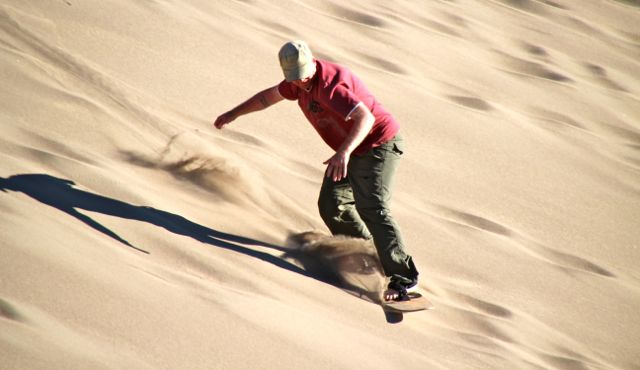
So my ongoing advice to myself is two-fold. Firstly, say yes. Do I want to try out my neighbour’s new crossbow over a couple of cans of beer? Yes! Though accumulated wisdom tells me that switching to Bourbon after we run out of Stellas is a bad idea. Through doing, learning, achieving, I grow. Secondly, there’s that consideration side of my equation. I need to reflect on my experiences, in order to develop. If the natural progression of spending Thursday nights firing bolts into bags of sand is dressing in a camouflage onesie and tracking sun bears with a loaded automatic weapon, then maybe it’s time to switch to sand boarding. I’m not so good at the killing.

In five weeks I’ll be looking up at the Pyrenees from a small town in the south of France, and taking my first steps on a five hundred mile walk that runs from Catalonia to Galicia. I’ll be exchanging stories over ciders, popping blisters next to open fires, and trying to avoid accidentally ordering octopus in Basque. My strongest motivator for this journey is introspection, both my own, and that practised by the other pilgrims. After around five weeks of walking I should reach the West coast of Spain, at a little place called Finisterre, and there I’ll look out over what was once considered the end of the world. And I’ll reflect on what I have done, knowing that while I might not have found answers, with some consideration I can at least ensure my experiences generate some wisdom.

I’d like to dedicate this to the memory of my grandfather Colin, a man whose wisdom I never took enough advantage of. But his curiosity about the world was inspiring, and I’ll be looking
out for him in the changes of weather above France and Spain. Laters Grandad.

Horizons (charging into)

Kapiti cropped large

Two days ago I finished writing a story. It began as a tale about two kiwis and a Canadian who decide to use gangsters and mobsters to market their new vodka, hoping to gain street cred and instead attracting a range of terrifying challenges. But I was somewhere between New Mexico and Utah two years ago, watching electrical storms on four horizons when I realised that Vodka just wasn’t enough. As I viewed spectacular lightning splitting dusky widescreen horizons, I knew my characters needed grander problems than smuggling spirits into Liberia and the Ukraine would earn them. I needed to take on something that would echo across the world, something which would require commentary from the Pope.  So these human lightning conductors decided to invent a better religion, and the vodka became part of the back-story. But that’s another story for a different day, publishers willing.

Soon after I began work on the book, I started writing this blog. As I set off on a research trip to the USA and Europe my life seemed to have become interesting enough for me to find something to write about every couple of weeks. I find that when I’m travelling I live at a much faster pace. Each day lived seems so visceral, so textured, so rich. Every meal is newly spiced, every conversation has an accent, every dawn is described by new sounds. Each morning makes a promise, that the day will harbour some lesson, some learning, some new understanding. I want to share the revelations, the encounters, the mistakes and consequences. And then I return home, and that pace drops away.

I haven’t posted anything here for eighteen months, not because I haven’t been inspired, but because the achievements were gradual ones, and their rewards were ones of delayed gratification. And because working in a job for an income rather than outcome stifles my imaginative creativity. It’s been a period of building for me, a passage of time during which I’ve managed to set myself up with foundations for a simpler life, one which enables freedom and creativity. And it has helped me further understand the joy of simple living, with kind and thoughtful people. But my passport hasn’t been soaked with the sweat of border anticipation for far too long, and my pack lies forgotten beneath my bed, comforted only by memories of a brief and beautiful jaunt through a Buddhist kingdom. And I want to write a new book, so I need character inspiration, semi-autobiographic comic relief and the rewards that come with making simple mistakes in unknown lands with friends I haven’t met yet.

I’m six weeks out from a flight to Paris, I’m buying walking shoes and train tickets, and my heart beats louder in my dreams. The world is opening up again, my skies are wider than an office window, the winter storms are all around me, unframed, unbound. The pace is picking up, the sound of a jet overhead has regained a personal significance, and as I watch others post photos and thoughts from Castle Donnington, Positano, the Orkney Islands, envy has given way to a feeling of fellowship. I’ve written 150,000 words about another man’s journey, it is time to slip back to first person perspective again. And it’s time to share my ideas once again, and hope to strike a chord, provoke a response, or even provide inspiration for someone else’s adventures.

The great thing about horizons is that just like tomorrow, they lie just out of reach. But unless we’re clinically depressed, our progress towards tomorrow requires no effort, no act of change, no brave decision. But to approach the horizon, that demands a building of momentum, a setting of sails, the anxious lottery of purchasing Easyjet tickets. And most of all it require the triumph of adventurous spirit over apathetic submission.