Category Archives: Uncategorized

On incorporate my writing into my living

beach-IMG_2790

When I decided to replace my painting non-career with writing, it was always with the intention of working towards a novel. It’s at least partly my Dad’s fault. Every wintery Saturday morning down at the Ngaio library, I’d end up lost amongst shelves of books that smelt like wisdom wrapped in parchment. My Pa introduced his three children into incredible new worlds, for the price of an occasional lost book. I know it’s unlikely that my book will shoot to the top of best seller lists, get optioned for a film, and in two years I’ll be turning down Ryan Gosling and Reese Witherspoon (shudder) for roles. But as the lovely couple who sold me a reconditioned typewriter on Paekakariki Beach explained, the most important thing for me is going to be self belief.

I needed help understanding my strengths and weaknesses as a fledgling author, so I took on a freelance writing course. I aimed to use magazine articles as a way to make money from the research and character development I was doing for my fiction. One of the key elements of my first tale is a very special vodka. I spent a month investigating vodka marketing, vodka production (first hand) and vodka history. And doing just a little sampling. Just a little, because to tell the truth it tastes universally shite. I ended up with an entertaining article on New Zealand’s vodka marketing stories, and a solid understanding of why you don’t challenge a Polish woman to make a distilled spirit from courgettes and boiled sweets. I found it was very easy to get side tracked investigating and researching.

I guess some authors wouldn’t need (or want) to employ “method writing” in order to communicate informatively and persuasively about Afghanistani heroin production, or the Modolvan slave trade. But without my time in Northern Ireland I wouldn’t feel comfortable writing of the effect of “The Troubles” on tourism in Derry. And without a confrontation with Hungarian gangsters in Budapest, it’s unlikely I’d develop a plot involving the Eastern European mafia. Admittedly Mr McKinnon and I would also be 3000 Euro better off, but even the naive decisions made fumbling your way through foreign lands inspire new ideas. Excuse for further travel…tick!

Locations and ideas though, are just the framework. My stories are fundamentally about people, particularly people who find themselves displaced. My characters have to be unique, interesting and truthful, or who would want to spend four hundred pages with them? I need a way to access other people’s perspectives, or my characters will end up as just different versions of me. Fortunately my writing course provided a solution, a set of assignments requiring that I conduct interviews. Now some might shrug their shoulders at this, but I had my share of shy times as a young fella, and the idea of attempting to pull intimate stories from strangers was difficult to get my head around. But over the years I’ve grown bolder about attacking my anxieties head on, so I procrastinated for only a couple of months. I conducted my first probing question-and-answer session with a talented New Zealand artist, Greg Broadmore. And of course my fears were unfounded, he proved more than happy to explain how he managed to develop his own opportunities in a country with negligible arts support. We downed pints and a couple of roti bread, and my only issue was remembering that it was an interview, not a discussion. Nerves eliminated.

Interviews have turned out to be not just an incredible source of character ideas, but also a tool for countering my misunderstandings. I’ve been developing a blind character, so I decided to write an article on how the visually impaired deal with social media. I imagined they must struggle socially every day, having to do without such useful social tools as winks, colour co-ordination and carefully applied lipstick. And I presumed that interaction had become all the more difficult with the gradual shift from face-to-face chit chats, to technology based relationships. I mean have you tried using Facebook with your eyes shut? Exactly. So I set up an interview with a blind gent who teaches people how to use “adaptive technologies”. I’d seen a picture of him in a newspaper article, and he had been photographed wearing a Metallica t-shirt for the interview. I thought either his Mum had played a cheeky wardrobe prank, or he was a metal fiend, and we’d click. I met him at his workplace, and click we did. I found he was ridiculously capable, and I was embarrassed by how much this surprised me. His Uncle and Father had been raised blind, so he was brought up as a kid that bumped into things, rather than an incapable, lolling eyed burden. And over a couple of hours of conversation, my character developed a voice that wasn’t just mine.

So now I listen much more closely when an old man in a pub tells me of the day he realised that maybe God had never listened to him nor his younger brother. I try to understand at what point a friend abandoned her hopes and dreams as something she might one day achieve, and began instead to project them onto their daughter. And I sit and share a coffee every morning with the homeless girl huddled with a border collie, because I’m trying to understand why when she speaks of the father who beat and abused her, she describes him as if he’s the next messiah.

I hope that through my attention to the lives of others, that my characters might earn a readers sympathy, their empathy, or their disgust. So next time I meet you for a pint, and ask how you how your new relationship’s going, be wary…

On trying to be different versus trying to be the same

58545_440049828552_6008108_n

As a young lad I once read something about how difficult (impossible?) it was to have a “free and independent thought.” This became an unmeasurable goal. I’d squint my eyes, push hard and come up with a thought, and then I’d examine it to try to determine where I might have derived it from. This introverted pastime soon merged with a wider desire to do things differently. Think Natalie Portman’s character in “Garden State”. From taking random missteps as I walked down the driveway at home, to making up new words each day (complete with pygmy clicks and space whale groans…), I set myself up to be a perpetual victim throughout my younger years. Fortunately I was socially adjusted (or societally adjusted?) enough to keep a little of this under the radar. Ginger lad plus imaginary friends equals a lifetime spotting locomotives and collecting other peoples cats.

Many years later I proudly explained to Kara (the anarchist-Canadian) that I’d spent my life attempting to think differently to anyone else, to come up with thoughts and ideas that few had considered before. She replied that this was the first serious thing that we didn’t have in common. She’d spent her life trying to find was in which she thought like the rest of the world. And on inspection I realised that was the truly different one in our particular and peculiar relationship. Oh shit.

So my attempts to separate myself from the crowd have at times been a little pretentious. But I honestly find that in many ways I struggle to fit the mould society shapes for its citizens. Just after University (now there’s a while other blog topic…) I flirted with the idea of fulfilment through acquisition,  the quest for happiness through stuff. Despite “Religion 201: An Introduction to Buddhism.” But it wasn’t for me. I found that I could fit all the things I needed to live happily in a 60 litre backpack. I’m content with photos of me with friends, music, and a notebook with enough free pages for me to sketch a characterful face, or write of my feelings for someone five thousand miles away. And though I love the cosy feeling of a home, I feel a constant urge to discover new lands and experiences. I dreamt of visiting Ireland from a very young age. And since discovering a slice of cold pizza and a “welcome, I’m upstairs downing Guinness” note from my sister in a backpackers on my arrival in Dublin, I decided to always set my sites on a new destination. That’s grown into an ever changing wish list of new destinations. Most governments build their structures around an ageing idea of everyone settling in one spot for their existence. But nomadism is back on the rise my friends.

On those years that I’m back in New Zealand I also find myself struggling with the concept of a “polite society”. The unwritten rules whereby we avoid inflammatory conversational topics, the “not talking religion, politics or trans-gender operations” at the dinner table. Recently I explained to a small group of people I didn’t know, that I was “line blind”, so they would have to excuse me when I frequently over-stepped it. Of course I know, I just don’t often choose to care. I don’t like the idea of restricting conversations based on minimising the chance of a difference of opinion. It prevents us from having our less worthy ideas and beliefs challenged. If you abide by all this convention, you’ll end up recycling the same 38 “ideal adult conversations” repeatedly between the ages of 24 and 67. So try not to ask me about the weather, or “how I know Judy” when we meet for the first time. Instead, ask me if I’m as aloof as I appear, or whether I think buddha could take Jesus in a UFC matchup.

There are deeper, more difficult differences within this boy, which I’ll discuss in the near future, but I know now that differentiation may well be the rule rather than the exception. I’ve met enough people from a variety of backgrounds to realise how important it is not to think I have the monopoly on new ideas. I’ve been humbled by the sheer variety of experiences I’ve had related to me. Many of situations and upbringings that others have endured have been uncomfortable to listen to, they’ve brought tears to my eyes and rage to my heart. These people sometimes emerge stronger, and more capable. But it’s not all happy endings, sometimes they’re left terrifyingly damaged. So now I’m disappointed by those who dramatise the difficulties they face, which endanger only their pride, or their societal standing. But all of these encounters help me understand myself, and as someone who wants to share stories of outlandish lives, they are an essential part of my education.

I think the one thing that is important, is that we take the time to understand each others differences, and to learn of other ways to live. It is intolerance and ignorance that conspire to push many of us to the fringes. I hope that eventually my writing will help at least a few people understand the value in living differently.

On nurturing the gentle art of pub conversation

222178_6606391002_4534_n

There must be few more delightful yet simple pleasures, than talking bollocks with your mates in a cosy pub. You slowly shift into the classic bullshitting lean, hunkering down over the table. You glance around the area to ensure no one likely to take offence is within hearing range. You take a slow sip of your ale, catch the eyes of your audience, and begin telling the tale. There are (in the pubs that I enjoy the most) expectations that stories accompanied by beer or cider shouldn’t be held strictly to facts. Tavern legends are born not from particularly awe inspiring or heroic deeds, but from a low key adventure which has been embellished and polished by each person who has retold the anecdote. They’re the magnification of a simple deed into a heroic task, through a pint glass shaped lens. Each new recital opts for a new gasp invoking twist, over the retention of any particular fact.

Up until fairly recently there has been an honour amongst chaps and chapesses, that runs along the lines of “if I tell a yarn about an incident which you were involved in, it’s the audience enjoyment that is important, not that it was the ranger who did CPR rather than Tom from down the chippy.” And under this unwritten rule, anyone else supplying details to the story should only do so if it’s likely to further stretch the boundaries of incredulity, or will summon further healthy chuckles. But in these days of mingled drinking masses, particularly in the cities and large towns, where transients drink with old hands, there are those whose presence serves to break the storytelling spell. They’re the pub equivalent of a thirty minute wedding speech by a drunken uncle. They interrupt at a crucial point to debate whose turn it is for a round. Or they attempt to tilt the tale mid-point, towards their own underwhelming experience of a “very similar situation”. Or worst of all, they invoke the most heinous of all modern story-telling spoilers. They drag out the smart phone. “I think you’ll find Pol Pot is very unlikely to have ever shared a joint while gutting catfish with your Uncle Finnegan in Faliburt, Louisiana. Google informs me that they haven’t caught a fish there since the 1930’s…” Take that infernal atmosphere eliminator and have him beaten (gently) with broken pool cues and assailed with Eastern European curses.

It was bad enough when the mobile phone first began its intrusive cries for attention down at the White Lion. How many engaging recitals of “the one where Kevin met that girl with the electric vampire bat” or “that time Simone went surfing with that albino preacher from Delaware” have been interrupted by a Nokia ring tone? Just as we’re all leaning in, enthralled in the latest version of a timeless saga, the storyteller is summonsed to “work”, or “the in-laws for sausage and chips” or “alcoholics anonymous”. Grr technology, grrrrr.

There is another insidious trend that threatens the continuance of lager fuelled oral traditions. The pub quiz. Now don’t get me wrong, in some quarters these are a hilarious excuse for engaging banter, an opportunity for the affectionate berating of the quiz master/mistress, and a chance to earn free pints for the most outrageous but plausible answers. But in general they monopolise the aural airspace, promote the worst sorts of train spotters to celebrity status amongst their “letters to the editor” writing peers, and fill the drinking spaces with far too many facts. A pox on any entertainment which provides a platform for the village trivia hunters. There’s far more pith and wit to be found in tall tale telling and the resultant banter, than in any argument over which particular inbred monarch invented the adhesive-backed pubic wig.

The local pub is a conversation harbouring institution on which we should all keep a wary and watchful eye. People need community stories, village myths, town folklore. In a world where stories of the sexual and financial misadventures footballers wives, hotel owners daughters and celebrity chefs special sauces are displacing those about local heroes, we need to take a stand. So next time you’re down at the Shark and Octopus, or the Loathsome Minstrel, maybe leave the iphone at home, take a moment to heckle the quiz master, and tell them the one where Gnasher lost his artificial leg in that bet with the gypsy fortune teller…

On the stories we create about ourselves

As we live life, we subconsciously construct a fairy tale about who we are. We take a few of the things we tell ourselves, a whole lot of things others tell us, and craft an incompetent portrayal  of ourselves. This then becomes an instruction manual for our future behaviour. It can affect almost every decision we make, from what flavour of Tim Tams we buy, to whether we have an affair with the butcher. We will seek out people who reinforce that belief, and most likely will be distrustful of those whose opinions don’t mirror our self assessment. These templates can be set at a young age, and may last, unaltered, until we are drooling down our flannelette nightshirts, propped against a radiator in a hospital corridor.

Ok, let’s personalise this. From a young age, maybe seven or eight, my story began to incorporate something like “Regan was born to be an artist…” Positive responses to my early drawings, enrolment in a specialist art course, and winning that skateboarding book, all contributed to my internal fable. This might seem innocuous, or even useful. But as I presumed this artistic competence was a natural ability, I didn’t push myself to extend my skills. Worse, I also began to excuse a range of my less positive behaviours, I just presumed they were part of my “artistic temperament”. My story shifted to something like “Regan is a great artist, a born talent, so he’s expected to rage against the slightest criticism, be spiteful of any form of conformity, and party today, for his great talent will no doubt be recognised tomorrow.” I’m awfully pleased I escaped my story with neither an addiction to opiates, nor a missing ear.

So how did I escape the bounds of my ridiculous tale? I believe it was the psychological equivalent of a solid hit to the head. Three years ago I was turned down for a position as a concept artist in the UK. My rejection note explained that they didn’t find my sketching advanced enough. Cue: huge sledgehammer hitting forehead. At first I argued with myself that they didn’t understand my style, that I hadn’t had enough time, that they hadn’t fully explained the brief. Cold hard facts were studiously ignored. How dare “they” confront me with something that conflicted with my self belief? But I was jarred, and forced to examine contradictory and heart breaking evidence. And in the end the only thing positive I could find in the broken fragments of my career as a painter, was an opportunity to edit my story. Haha, and somewhat ironically, that’s when I decided it was time to try and make a living through writing.

What would they know...
What would they know…

Some stories though, are much more harmful, and difficult to transcend, than mine. We can end up supporting a story of ourselves as worthless, or incapable of love, or undeserving of positive relationships. Abused women and children can convince themselves that they somehow deserve punishment, and long after they escape one brand of torment, they find themselves gravitating towards further victimisation. It’s those of us that end up trapped in stories like these, that need to understand what drives them to sabotage their choices. Recognition of our stories is the first step towards being able to affect them. And if we recognise this in others, we owe them assistance.

It’s not all gloom with a side-salad of doom though. Some of us are capable of subconsciously manipulating and changing our stories in order to improve our lives. A very good friend of mine had an extremely difficult time getting through her first degree. She attended lectures and tutorials, she studied, she understood what she was taught, but somehow when she wrote essays and dissertations, they didn’t reveal her depth of understanding. On preparing to face another bout of academia several years later, she was tested for learning disorders, and told that she was dyslexic. Now many people might see this as a grim setback, but such was her force of will, she managed to do the opposite. She researched the range of conditions clustered under this title, and determined that some of the greatest thinkers of the last couple of centuries had been posthumously diagnosed identically. And then she turned it into a super power. Rather than mask or hide her “difference”, she boasted of it. She told me she felt sorry for those mere mortals who functioned normally. This was astounding to watch happen. It took a few weeks to solidify, but once it did, none of my arguments (her statement that I was intellectually disadvantaged didn’t match my story, so argue I did…) affected her newly formed tale.

Not all of us are this resilient, but I think that if we can find ways to understand our stories, and how they affect our choices and behaviours, then we can gain power over them.

On learning from others. And yourself.

Note where the sun's shining from...
Note where the sun’s shining from…

Last winter my long term relationship came to an end. I met Alison whilst working in my sister’s backpacker hostel in Northern Ireland. When I first met her, I thought “Naaa[maybe]”. Over the next few weeks this progressed to “Maybe [naaa?]”, finally I ended up at “Hells Yeah!” It came down to me waiting at an airline counter in Dublin. I asked the Ryanair check in woman to toss a coin for me, as I couldn’t tell whether I should stay in Ireland and pursue the Northern English crumpet, or head on to new things. Even now I can’t remember if she actually showed me the coin, I just remember her Irish accented “teeyils!” and the accompanying grin.

Alison meant a lot to me. She was my moral compass, a pretty solid white yin to my somewhat dark yang. We had a chaotic time chasing opportunities around the globe. We also went through a lot of difficult struggles in our attempts to stay together, but we’re both prepared to fight for the lives we want to live. But in the end it was the children that undid us. She wanted them. By the end she wanted them soon. And I couldn’t solidify an answer on the topic. Or an answer that wasn’t “No”. So she left.

Yip, it hurt, and my first instinct was to numb the pain that accompanies my particular brand of self doubt. I clambered aboard the crazy train, bound for Shitfaced, Nebraska. But I soon began to recognise a guttural ugliness in my barfly conversations. So I gave myself a metaphorical slap about the face, and decided it was time to use loss as a catalyst for something positive. I dropped the alcohol (most of it…), bought an old Olympia typewriter and exorcised the bad thoughts through frantic keystrokes. I entered the summer with a slowly expanding manuscript, and the fizzy enthusiasm that the warming sun and smell of freshly mown lawns brings out in us kiwi’s.

I began sharing the season with a range of travellers, through Couch Surfer. My lounge and deck became a mini backpackers, and in exchange for a place to sleep, and my delightful company, I harvested their stories. From mental health nurses to snake breeders, I had a whole new range of ideas for character traits (and flaws…) along with enthusiastic punters with which to re-explore my city. The last of these near-random friendships was an American film maker, Francoise. Her and I spent the end of summer squeezing a hundred adventures into the shortening days. And in between chaotic film making, we spent the evenings attempting to unlock such mysteries around how we all determine our self worth, and how to best represent the mating of a shark and an octopus, in the form of a pie. A perfect blend of introspection and the surreal.

As the weather shifted from beers on the deck to hot chocolate in front of the fire, an astounding friendship was formed. From time to time we all need someone else to help us to get some perspective. Over ten weeks Francoise and I realised we’d found someone who helped us better understand who we were. I’ve spent many years learning to talk about what I feel. Kiwi blokes born in the 70’s don’t function that way, but a failed marriage stood testament to where being staunch gets you. One of the benefits of knowing how to explain yourself to others, is that there is a chance that they will then be able to share with you. And I now get to understand the heart of someone, whereas for years all I tried to do was to get someone to laugh, or cringe, or use a mini-tramp and a matress to do dive rolls over a bonfire.

Alison and my separation took my overly cynical outlook to ugly new places. But fortunately I realised that dwelling in dark places only prepares you for a life in the shadows. My writing had been depressive, anxious, and occasionally cruel. It needed to progress, to be more balanced. Several years ago I decided to take up snowboarding. Just before I first thundered my way down the beginners slope on a rental board, a helpful friend told me that I’d go whichever way I pointed my head. Then he pushed me into the snow. His technique though, was a significant step forward in my attempts to protect my arse and my dignity. I’ve found that my life can be like that, if I point my face towards the warmth, that’s where I tend to drift. I might take a few good falls on the way, but at least when I rise I’m looking ahead. And hopefully this is reflected in my words.

Francoise, I’m looking forward to continuing to head on into the warmth with you. Thank you for helping make this kiwi summer the best one I can remember.

On being the boy with the unicorn tattoo…

Eighteen. Impressionable. Ridiculous. Helen was studying philosophy. She introduced me to Nietzche and Hegel. I introduced her to a book about a unicorn. Seriously. If I’m honest it might well be the only thing we had in common, she’d grown up with an interest in unicorns, and I’d once read a book that included an entertaining look at how to ride one. Quite how I made the mental leap from “we both know what a horned pony looks like” to “if I get a tattoo of a horned pony Helen will think I’m a romantic yet somewhat rough villain-hero” I’m not sure.

Rogers Tattoos, on Cuba Street, Wellington. If you look in the window now, you’d think twice. Actually, you probably wouldn’t think once, you’d decide that you’d rather go under a needle in Pat Phong Road, Bangkok, and take a chance on the AIDS. But that many years ago it seemed just the right degree of seedy, yet somehow as a ginger teen, still approachable. I don’t know how Roger (I’m assuming only the proprietor would be allowed to tackle such a stellar artistic concept…) suppressed a giggle. And in hindsight I’m a little disappointed he didn’t at least breath test me. It took around an hour, cost $60, and I was rocking a gothic unicorn portrait on a blood red heart.

The healing went well, and I anticipated the revelation for days. A group of us first years was doing a road trip away to the might Hawkes Bay, the seaside, in summer. I presumed that Helen and I were destined for nothing less than a whirl-wind romance, and hopefully years of philosophising (as I understood it, this required lots of red wine, and making up arguments that could never be proven or disproven) and sex. On the heated afternoon of arrival, we changed for a trip to the beach. I wore a muscle shirt and a towel around my shoulders, and managed to hustle a position next to Helen in the back seat. I shrugged the towel free of my shoulders and made several attempts to pass things forward to the front seat punters, leaning my unicorn adorned shoulder under Helen’s gaze. “What the fuck’s that?” she asked as I reached forward for a coke.

No. No that’s not quite how I imagined the moment. Nor did I foresee the giggle. Do you know how warm the combination of being a sensitive ginger teen, being crammed into the back seat of a Datsun on a warm summer day, and suffering the most embarrassing seconds of your life is? I sweated. I cringed. And that sense of twisting shame struck a far deeper scar than the needle driven inks in my right shoulder. I went off Helen that day. And philosophy.

It’s somewhat ironic that the story of that summer has provided far more enjoyable results than the event itself. I once met a unicorn tattoo wearing Polish chiquita, the look of distrust when I told her I had a matching my little pony shifted to undisguised joy as I bared my arm. That’s right kids, unicorn foreplay, probably as rare as the beast itself. I don’t think I’ll ever be super-proud of my first tattoo again. But I was given the opportunity to cover it up with another a few years ago, and it felt a little like admitting it was a mistake. And I’ll do anything for love, but I won’t do that…

Unicorn 2

On the difficulties of trying to make money from drawing pictures…

I started off my artistic career drawing airports on cereal boxes, filling old phone books with animated sword fights, and making birthday cards illustrated with dragon-sharks. My first significant art win was at age nine. A class competition to do the best picture of Paddington Bear snagged me the unfathomable prize of a book on skateboarding. My skating never really took off, my mothers snapshot of me standing on my brothers board with a cushion belted to my arse attests to that. But the recognition for something which came so easily to me shifted my world. Two years later a classmate offered to buy my life-size painting of a Star Wars character from me. A liberal arts career was forecast.

Unfortunately I encountered an arts teacher soon after, who was to divert my creative career options. Mrs Manthell managed to put me off arts training for life. Freedom of subjectwas an alien idea for her, and her attempts to force students down narrow channels frustrated me. The top art prize that year went to a representation of a crisp packet. Andy Warhol’s influence on the Newlands College art curriculum forced me to conclude that I would have to teach myself. And without any significant honours in art subjects, I had little choice. Within three years art became a side project to my hormonal urges, and I seemed destined to produce intermittent album covers, band posters and tattoo designs.

As I moved beyond university, and particularly as I began to travel, I became more interested in what was happening in the wider world. My ideas on how I might use my paintings changed dramatically. While I was still focussed on creating attractive images, stories of climate change, and a resurgence in Somalian led pirate attacks were what fired imagination. I spent three years attempting to promote my political ideologies through my artwork. I had the best of intentions, I wanted to inform and educate through my detailed, symbolic paintings. But I lost my audience. I found that though a picture might tell a thousand words, the words were different for every viewer. And somehow without a recognition of the underlying stories, my paintings didn’t work. And didn’t sell.

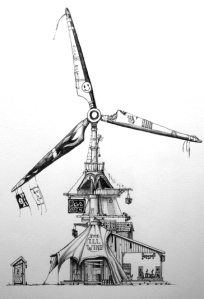
Turbine lightened

At this stage of my life I had yet to make any significant money from my arty farty endeavours. I’d taken on whatever job kept me fed and liquored, from catering weddings in Cambridge’s finest cafe (yay Michaelhouse!) to assisting with chainsaw sculpting in the North of England. My artwork was always to be my escape from mundane career options, and a crushing end to a potential career as a concept artist saw me facing a crisis of faith. A lifetime grafted to an office desk loomed. But my girlfriend at the time offered me fresh perspective, she (bless her) had enough belief in my creative goals to offer me redemption through another medium. She pointed out that my writing was my stronger voice, and that when I wasn’t waffling or ranting, it was a more effective way to deliver complex messages. An epiphany by proxy. Within hours I found a course on freelance writing with the London School of Journalism, dropped most of my savings on the first terms fees, and grinned as any hopes of a sensible lifestyle quickly receded.

I love meeting new people around the world, and learning from the stories they tell of their lives. I want to use these experiences to create imaginative and engaging fables. I’m not sure how this will earn me enough money to survive, but long ago I realised the importance of living with passion. I think that when we find something that fuels our enthusiasm for life, we owe it to our ourselves to engage with it. Even when it’s not the most stable or sensible option. A drinking companion once told me that the saddest three words in the English language are “I used to…”, accompanied by backwards glance at what might have been.

On ignoring social conventions

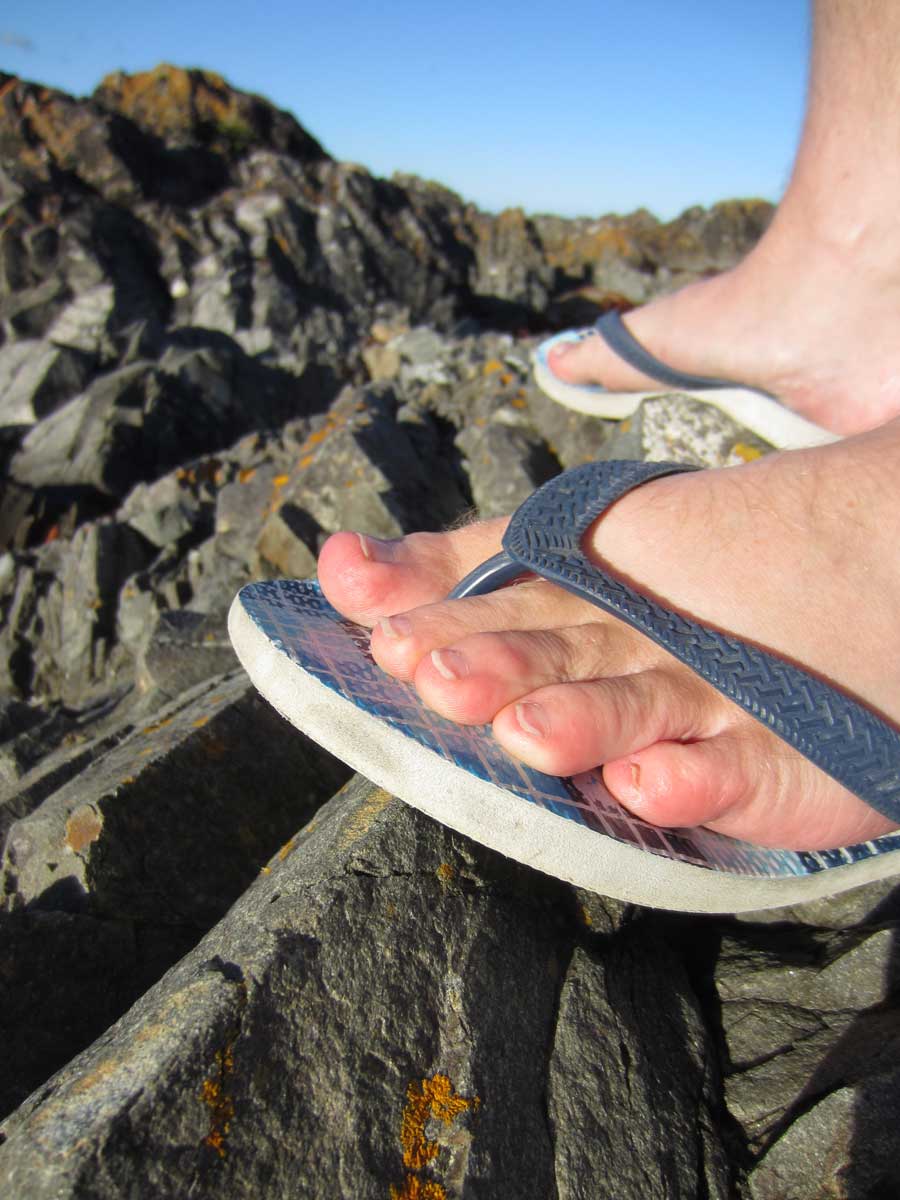
My name is Regan, and I’m a writer. It sounds like I’m introducing myself to some form of group therapy. Maybe. Anyway, I was born in New Zealand in the 1970s. This means that I was raised to believe that footwear was optional, and that when it was worn, it shouldn’t conceal much more than the sole of your foot. For those of you that have never been fortunate enough to meet a “Kiwi” (native New Zealander) in the wild, we like to navigate the world in a set of unconventional national footwear known as “jandals”. Outside of our country they’re known as flip-flops. Whether we’re trying to impress the impressionable young ladies at a party, scale icy mountain peaks in the alps, or kick start a trail bike, we’d rather be doing it with the breeze sifting between our toes.

feet-IMG_5866

I had no idea when I began travelling, that the desire for foot freedom wasn’t universal. My first serious case of footwear-based culture clash came soon after I leapt off the “Green Bridge” in Budapest. I didn’t plummet the full 100 feet into the mighty Danube, but rather crashed to earth after an ungainly intoxicated free fall, and injured my heal. The next morning I decided to limp around the old town in bare feet. As I began that slow waltz across crowded cobblestone avenues, I started to understand cultural differentiation. I could have worn nothing but a bacon loincloth and attracted less attention. Barefoot back home was glorious toe freedom. In European cities it was social suicide. Mothers didn’t shield their children’s eyes, but only because the kids themselves pulled their hats lower and collars higher. The Czechs were little better. Paul (my travel companion and fellow cultural ambassador) and I had to flee Budapest in a hurry (us + Hungarian Mafia = sudden loss of cash and threats to make us part of an all male review…), and ended up in Prague. The denizens of the old square were as dismayed at my flagrant toe exposure as the Hungarians.

So now “Inappropriate Footwear” is an analogy for the way I live my life. I repel even gentle social conditioning where it contradicts my own ideas and opinions, and I aim to walk my own path. Where possible bare footed. Many of my choices and actions generate the same gentle head shakes and tutting sounds I experienced wandering the flagstoned pathways of Central Europe. These rebukes would have triggered a case of blushing cringe when I was an uncertain, gangly, ginger teenager. But as the passing years have faded my ruddy mane, they’ve also provided enough life experience for me to understand that a homogenised society is a dreary and hollow idea. It is supremely important to promote new ideas and controversial opinions. It is entirely valid to live a lifestyle that is not the one promoted by society, or its biggest behavioural inhibitor, the media. So I’ve learnt to live as much as possible in a way that makes me happy, and to understand that being like everyone else, blending with the masses, doesn’t necessarily contribute to that happiness.

But just doing this, it isn’t enough. Not for me. I love to express my opinions on those ideas that I see as important and under-represented, sometimes with a Tourettes-like degree of enthusiasm. Unfortunately this occasionally offends, my last sentence for example might not sit well with the siblings of the grunting, cussing and sparking sufferers of that socially crippling neuropsychiatric disorder. But there are serious considerations behind the idea of freedom of speech, and we should all beware of attempts to neutralise language to the point that it can no longer elicit emotion. Offence is rarely my goal, but triggering thoughtful reflection is, and emotions are the frequently the offspring of considered thoughts.

So this blog is the new forum for my ideas, and my storys. It will help me test concepts for my articles and books, keep people informed of what devilish things I’ve been up to, and be a record of my upcoming journeys. At times it will be embarrassingly honest, which I hope will help people to empathise with some of my experiences. Or at least elicit a few belly laughs (for those under 25, these are lol’s that come out of your face and cause your guts to tremble). At best I hope that occasionally I’ll challenge beliefs just enough to inspire further thinking. At worst I’ll end up with a list of embarrassing things I’ve done, being recorded forever in the public domain, and sabotage any chance of a political career. Probably a good thing…