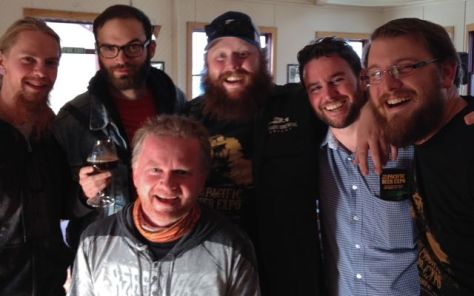
I once sat between two huge men in a seedy Budapest bar, hoping my mate Paul wasn’t being drowned by their companions in some dark stretch of the Danube. One of us (I don’t think either of us remembers/admits whose idea it was) told the other “let’s get a cab to the seediest pub in the city”, and there I sat, dripping with sweat and regret. It was a situation which taught me several things. That I can trust Paul in a sticky situation. That if you’re unable to pay a debt to the Hungarian Mafia, then you get pimped out in live sex shows. And that my desire to experience more of life occasionally threatens to shorten it.
The other significant understanding that hindsight offers, is that my willingness to engage with as many different ideas, experiences and people as possible, builds the parts of me I’m most proud of. I believe there is a cost in denying myself an opportunity to try something out. The price is ignorance, reduced opportunities. And most disappointing of all, it means fewer chances to overlap with other people.
It frustrates me when people reject things without strong reasoning. “I don’t dance, I don’t read anything by female authors, I’ll never watch anything made by Disney.” It upsets me when I realise I’ve rejected something from a place of ignorance, from prejudice. Short-cut thinking is something I battle against, mental laziness. And sometimes it really is a battle. It is easy to maintain a huge list of ideas with a yes/no indicator next to them. Do I give a shit about dinosaurs? No. Do I care about someone else’s faith? No. But I find it is then very difficult to undo these binary indicators.
Instead though, I can leave a space next to anything that I haven’t tried. Am I going to be impressed by walking in the footprints of dinosaurs in Colorado? Blank space. I’m far more likely to convince myself to give something a try, if my mind isn’t already saying “not interested”. And once I’ve built a history of saying “Cool, I’m up for it”, then the momentum of previous exciting experiences builds, and it generates FOMO as a by-product. And the Fear Of Missing Out, is a great counter-balance to niggling anxieties about exposure to shame, embarrassment, or naked flames.
I’d like to congratulate my family for their contribution to this mental attitude. I grew up with two siblings, and though we all shared a love of hair metal and bourbon, we also developed independent ideas of what constituted a good time. For example my brother was the martial arts one, and my sister the horse riding one. And growing up with them meant I watched them find grins and LOLs in places I hadn’t been. And eventually I guess it was FOMO again, which led me to dabble in their respective arts. So one day I trained in Japanese sword fighting, which led to my involvement in the Lord of the Rings films. And another time I began taking riding lessons, which has led to trots amongst the fairy chimneys of Cappadocia, tolts through the snow on Icelandic horses, and limb-ducking gallops across Czech forests. Oh, and several friendships, and a marriage.
My Dad didn’t do anything to counter my desire for diverse experiences. First, library visits with him meant I found joy in reading science fiction, Aesop’s fables, and to a lesser degree the ingredients on a can of toilet spray while I wait for difficult movements. This led to a (at this stage embryonic) career in writing, an inescapable interest in foreign lands and people, and a solid knowledge of non-CFC propellant mechanisms. Dad also had a strong desire to be his own boss, twinned with a low tolerance for boredom. So his decision to wear many different hats (firman’s helmet, chef’s toque, SCUBA mask) contributed to the ease with which I visualised myself as a chainsaw sculptor.
And then my wonderful Mum, she trained as a nurse, she worked with special needs kids, and then she led her and my Dad into a career in the wine industry when she decided to train in viticulture. So yip, I blame her for my weakness around an open bottle of wine, but also for my compassion, and that one time I worked as an art tutor with vulnerable communities.
So I have my family to thank for one of my greatest super-powers. And one of the greatest benefits of this power, is that it helps counteract a natural shyness. My readiness to consider almost anything has resulted in an interest in almost everything. I find that in general, when I meet someone new, I can usually find areas of commonality. Of overlap. This isn’t necessarily a shared experience or expertise, but if I haven’t told myself I don’t give a shit about laser holograms, then each time I encounter something around them, I build a little understanding. I write something other than “NO” in that blank box. And so when I meet an old Canadian scientist in a mead-dealing pub in Cesky Krumlov, we share an evening of stories, laughter, and herbed honey wines.
Common ground is a wonderful place for two people to start building a conversation, or mutual respect, or a plan to spend more time together. It doesn’t matter that I’m a Kiwi of no fixed career, and she’s a world class Brazilian surfer, my ability to find joy in more things rather than less, means that I’m more likely to be as interested in her side of the conversation as my own.
I’m far from perfect. There are plenty of things that I reacted against with minimal information. But I didn’t write “NO!” in the boxes next to Drum and Bass, or Trailer parks, or Bluegrass, and so when I eventually tried them, I discovered some of my most transcendent escapades. So I’ll push myself to maintain an open mind on as much as life as possible, because each new experience is a teacher, and each teacher guides me from places of ignorance, towards greater communion, towards stronger friendships, and towards being a more capable human.
 Inappropriate Footwear