Tag Archives: history

Capturing stories (and working for the greater good)

Around three months ago now I finished full-time work in order to have the time to focus on two endeavours. The first was my fiction writing, this had been tainted by working in a role that eschewed imagination, and moving to the country has given me wider horizons in which to let my imagination gallop and play. The second was my supporting role in a new company, a venture whose goals were more compatible with my morality and world views. A business which believed in the cultural value of stories.

Cards two

I’m a huge believer in the power of a good story. That’s both blessing and curse as a writer, as it inspires me to want to write great books, but it means that rather than simply telling a tale, want to weave ideas through the text which might inspire, transform, or at the very least inform, rather than structuring them like a film and hoping for a movie deal. I feel a need to honour all those story tellers that came before me, because I know how important their contribution was to my world.

When we are young, if we are fortunate, then we had a relative who would induct us into the world of guided imagination. They might have told us stories from their past, or stories from their imagination. They might have read us tales from thick books, compilations of fables curated by Aesop or the Grimm brother’s, maybe they ad-libbed a little as they read, or added in sound effects or frights, perhaps they changed voices for the talking bear, the frustrated witch, or General Woundwort. Those recited words can play a huge role in our development, helping us counter arachnophobia (Charlotte…), inspiring us to travel (every Irish, Norse and Navajo legend I ever heard), or simply inspiring us to learn to read ourselves, so that there was never ‘one last story’. Not while there was a functioning flashlight in the house.

As we get a little older many of us learn to read ourselves, and we begin to choose our own stories. I remember finding a copy of Peter Benchley’s ‘Jaws’ on the book shelves of a holiday house one wet summer. The thick book had the infamous movie poster on the cover, gaping shark jaws open below that late night swimmer. I’d anticipated sharks and drama, I hadn’t expected sexual explicitness. I took to reading it outside or at night, where my blushing resisted invocation or at least detection. And when we leave school in order to become the protagonist in our own tales, hopefully we continue to read. I have found solace, wisdom and inspiration in books my whole life, worlds to escape into, and things to bring back from them, into my own narrative. Including a little from Jaws.

The company I’m working with exists to assist with people with the preservation of stories. We work to create copies of items of enduring cultural value, and enable those copies to be shared with people separated by time or distance. We make detailed copies of cave paintings, maps, books, artworks and carvings. Similar endeavours around the world are mapping ancient civilisations from the sky, or using technology to help rebuild the walls of ancient temples, jigsaw puzzles with one tonne pieces. Efforts are being made to capture everything from baseball cards and comics to death warrants and viking longboats, as they’re all vessels for stories.

My daily tasks for the company vary, sometimes I’m driving to small coastal towns to capture fragile maps, more frequently I’m processing thousands of images, from fashion drawings to diary entries. But a two things I’ve encountered in the past week helped me understand the value in capturing so many aspects of culture, as I colour correct yet another photo. First I was reading through the ‘About us’ page on ‘WikiLeaks’ for information for an article, and amongst their principles was ‘the improvement of our common historical record’, and this idea sat with me. Then last night I was reading a few passages from a book called ‘Woman who run with the wolves’, by Clarissa Pinkola Estes. She talks of the importance of information passed from generation, as myths and stories, and how so many of these have been altered by the dominant society, stripped or altered so suit the dominant religion, or sense of morality of the time. And in the process we lose important elements of the original story. And I realised, we can’t let the recording of history be the province of a select minority. That has led to one-sided tales, to distortion, to the eradication of cultural elements, and often to the elimination of the female perspective. Instead we need to capture as wide a gamut of society, of culture, as possible. The hauntings, the messiahs, the sasquatch, the unicorns, the trolls, the elves, the barbarians, the werewolves, they are so much of who we were, and who we might be.

So I’m proud of my two paths. I’m pleased to have continued to write every day, to try to improve my story-telling craft. And I’m proud to be working with Heritage Studios, with creative people, helping capture other people’s stories across the Pacific.

If anyone would like to support Heritage Studios in their story-saving mission, please look us up on Facebook, and like us if you like what we’re trying to do!
https://www.facebook.com/HeritageStudiosNZ

From Ireland to Holland

Holland 2

I flew out of Dublin on Sunday, just hours before a set of airplanes were due to do a flyover of the River Liffey. Initially I was worried I was missing out on something rather grand, but two things shifted my disappointment to joy. Firstly I found out that the flight line-up included a jet owned by budget airline Ryanair, which guaranteed there would be delays and timing issues. Secondly, as we touched down in Maastricht a pair of biplanes with acrobats on their top wings flew over us, performing slow barrel rolls. They were bewitching in their lack of caution, and immediately I felt I was somewhere just a little bit special. Intimate daredevil acts rather than overblown theatrics, that’s the way to this boy’s heart.

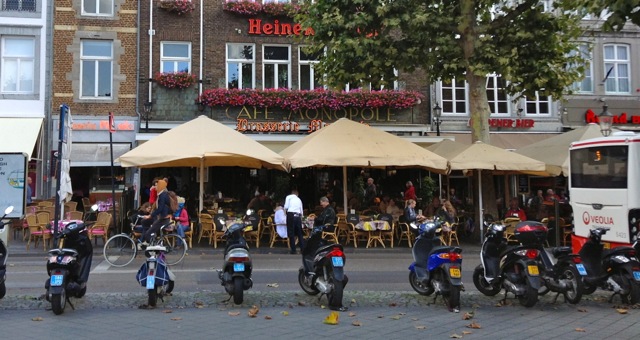
Maastricht rests at the base of the Netherlands, nestled between Belgium to the West, and Germany to the East. Soon after our arrival Francoise and I are led to the city centre by her friends (and our enthusiastic and engaging hosts), Ilja and Ivo. As we walk towards the spires that lance the skies above the city centre, the streets shrink and the buildings grow. While strolling we’re constantly passed by cyclists on gearless grandma bikes. The age of the bikes and their poorly mounted bells ensure they never approach silently as they judder and clatter down the bricked lanes. My mood shifts between delighted and charmed as I hear and smell the cafes and bars, and glance down the narrow alleys that run between the aged building frontages.

Churches and cathedrals are often the most impressive structures in European cities and towns, and this place is no exception. But as the spiritual requirements of nations and their populace change, these buildings frequently languish in ghostly silence. Here though, the religious monoliths abandoned by those whose faith has evolved are being resurrected in some very interesting ways. Their gothic and baroque shells are providing beautiful usable spaces, and the result of these renovations are locations thick with atmosphere, and enlivened by their renewed purpose.

We start with a visit to one of these updated properties, which the Guardian newspaper called “the most beautiful bookshop in the world”. As we enter between thick steel doors I’m spellbound. In 2008 the centre of this ancient Dominican church was filled with a three-story skeleton of black steel bookshelves and walkways. Cleverly the hollow structure ensures your views of the thirteenth century stonework are barely impeded, no matter which way you look. The more functional appeal of the towering steel work, is that it enables me to get closer to the ceilings as I ascend the stairways. Up here the carefully lit stone ceilings offer up their artful decorations far more effectively than from the floor a hundred feet below. I shudder a little as I can almost feel the haunts peering over my shoulder as I flick through novels and magazines.

Our next stop is another post-religious renovation, the Kruisherenhotel. This sixty room conversion is a brilliant example of converting the intimidating to the intimate. The lighting must take the most significant credit for the transformation, diffused spotlights are used to accentuate the past as much as they are to illuminate the present. The placement of modern sculptures between ancient detailing doesn’t push the boundaries of taste, and the use of the padded doors from the old confessional booths inserts a softer texture between the hard stone and steel.

These sympathetic installations help to highlight the pride of the citizens of this old city. They have ensured that the past hasn’t just been preserved, but that it is functional, that it is integrated into people’s lives.

Yesterday was a day of less metropolitan pleasures. We boarded a boat tour on the Maas River, bound for four locks, and a nosey at what canal living was like. It was a journey of the simplest comforts, my belly was warmed with Nescafe coffee, and filled with home-made cheese and pickle sandwiches. The Dutch commentary was intermittent, and fortunately translated by Francoise. Entertainingly the gaps between the captains explanations were filled by an eighties mega-mix. The sounds of Roxette and Tears for Fears tunes built a nostalgic backdrop and put me in a contented mood as we drifted along the waterways. We passed rowing teams, long barge houses and occasional upset geese, and the even the grey skies and patches of rain couldn’t mute my pleasure.

Somehow this city has quickly drawn me in. I’m enjoying picking out what I can from the written and spoken Dutch language, it seems to draw enough from German and English to make translation an entertainment rather than a chore. I love that the people are frequently on bikes or foot, and perhaps as a result there are few signs of the obesity issues of other places I’ve been travelling lately. And this despite every delicacy I’ve tried so far being either very sweet, or being cheese.

It’s interesting to compare the way I feel here, to the way I feel in Ireland. If cities might be people then I’m pretty sure Dublin is a dishevelled old bloke with a taint of beer and loss, who covers his concerns with cheeky bravado. He’ll never quite earn my trust, though I’ll not forget him in a hurry. I always feel a little more at ease when I leave him behind. Maastricht on the other hand is a tall, sensibly dressed woman in her thirties. I noticed a small curious tattoo on her wrist every time I chat to her, but her banter would be so engaging that I would always forget to ask about it. Like the presence of the tattoo, her tales about her life always leave me with at least one more question at the back of my mind.

I’m very thankful for the circumstances which drew me here, I only wish I had more time to take on what this region seems to offer. I’m sad to be leaving Lady Maastricht in  a couple of days, but I guess there’s always another tomorrow.