Tag Archives: stories

Unbinding myself from my masculine story in order to grow

Women

Photo coutesy of the fantastic Roni Kay…

There have been two points so far, at which I have had to re-invent my novel. The first was when I realised that the central story wasn’t big enough, and I replaced a distinct vodka with a unique religion. The second rewrite became unavoidable when I realised that if half of my characters were going to be female, I had a lot to learn a lot more about what it means to be a woman.

That epiphany was the result of three awkward periods of self-discovery. I experienced the first of these after I managed to almost completely destroy a friendship with an adventurous and astounding woman, Elza, through my inability to understand her perspective. The two of us spent several months travelling together, and yet the whole time we also moved further apart. The silver lining to what was a dark cloud was that honesty on her part allowed for introspection on mine. I was at least able to learn a valuable, if emotionally expensive lesson.

The second flashlight to be shone on my gender naiveté was held by another inspirational woman, Linda. I’d always found ways to convince myself that there were no vast differences between men and women, that it was simply our individual experiences that led to misunderstandings. But Linda helped me see that as my own experiences had only ever been as a man, I had ended up with a strongly gendered bias to my thinking. Yes, I was a product of all the things that had happened to me, of my environment, of the people I’d spent time with. But it would have been impossible for a woman in similar circumstances to have the same experiences. Society’s attitudes towards gender trumped my hope that we weren’t so different as we all seemed to think. Shit.

Around this time I read a Margaret Atwood quote, which compounded my understanding:

“Men’s great fear is that women will laugh at them. Women’s great fear is that men will kill them”

I spent some time bouncing between the two sides of that quote, combating my defensiveness. Both Margaret and Linda had helped shift my perspective in a new direction.

The last twist to my viewpoint was a short, sharp one, encountered around half way through the film ‘Wild’. In the scene that challenged me, Cheryl Strayed is alone in the woods, and she’s approached by two hunters. My presumption at this point was that things were going to go dreadfully wrong, and I wanted to be anywhere but in the theatre, watching what I thought would happen next. It was my intense relief when the men didn’t attack her that shook me. For years I’ve tried to point out that the media’s to blame for other people’s heightened fears, but I have to accept that I’ve been shaped by the way ‘they’ portray the world as well. And if the media’s amplification of a history of men subjugating women has made me uncomfortable at the idea of a woman caught alone by two men in the wild, how much more fear must that idea hold for some women?

I spent a lot of long walks rattling around inside my head after that, trying to make sense of all this. I explored my past. To what degree had I sexualised past friendships? How many relationships had I destroyed through wilful ignorance? How many women had I scared through my actions, or words, or attitudes? It would have been easy to tie myself to my failures, to see myself as a bad person. But in my heart I believe that I am good, and that I am the engineer of my own future. So I decided I needed to stop digging a pit and start building a bridge. I resolved to do better, to be better.

The interesting thing about taking so long to write a novel, is that the rewrites can mirror your experiences. This rewrite of my story began with a look at my characters. One character was blind, and I’d spent a lot of time trying to write as a person without sight, as someone who draws the world inside her head. But two of my four central characters were female, how much consideration had I given their experiences as a women in determining their paths through the story? Not enough.

So I began to read more by female authors. I examined the great conversations of my past, how often was it a woman who kept me awake, offering me new ways to examine Christianity, or gun control, or Israelis? Or Batman?

And then I walked from one side of Spain to the other, usually in the company of astounding women. And through this time I began to rewrite my female characters, as women. My principal character is a man, but he had to change too, his motivations, his confrontations with himself, the impact of these women’s new decisions on his plans. In fact he really had to step the fuck up. To say much more would give away too much of the plot, but I know that when I write the foreword I will be thanking a number of influential ladies.

I don’t want to be an apologist for men, I don’t see much value in trying to explain what shaped my biases in the past. But I do want to say thank you to all the people, men or women, who have contributed to me being a better person today. Some of you managed to improve my world view in as little as 24 hours, astounding. I will always be to a degree the result of what surrounds me, so I’m making a promise to myself that I’ll continue to as often as possible surround myself with good people. And I make a promise to all of you, that I will do my best not to cause fear, or anxiety, and to try to put myself in your shoes.

Capturing stories (and working for the greater good)

Around three months ago now I finished full-time work in order to have the time to focus on two endeavours. The first was my fiction writing, this had been tainted by working in a role that eschewed imagination, and moving to the country has given me wider horizons in which to let my imagination gallop and play. The second was my supporting role in a new company, a venture whose goals were more compatible with my morality and world views. A business which believed in the cultural value of stories.

Cards two

I’m a huge believer in the power of a good story. That’s both blessing and curse as a writer, as it inspires me to want to write great books, but it means that rather than simply telling a tale, want to weave ideas through the text which might inspire, transform, or at the very least inform, rather than structuring them like a film and hoping for a movie deal. I feel a need to honour all those story tellers that came before me, because I know how important their contribution was to my world.

When we are young, if we are fortunate, then we had a relative who would induct us into the world of guided imagination. They might have told us stories from their past, or stories from their imagination. They might have read us tales from thick books, compilations of fables curated by Aesop or the Grimm brother’s, maybe they ad-libbed a little as they read, or added in sound effects or frights, perhaps they changed voices for the talking bear, the frustrated witch, or General Woundwort. Those recited words can play a huge role in our development, helping us counter arachnophobia (Charlotte…), inspiring us to travel (every Irish, Norse and Navajo legend I ever heard), or simply inspiring us to learn to read ourselves, so that there was never ‘one last story’. Not while there was a functioning flashlight in the house.

As we get a little older many of us learn to read ourselves, and we begin to choose our own stories. I remember finding a copy of Peter Benchley’s ‘Jaws’ on the book shelves of a holiday house one wet summer. The thick book had the infamous movie poster on the cover, gaping shark jaws open below that late night swimmer. I’d anticipated sharks and drama, I hadn’t expected sexual explicitness. I took to reading it outside or at night, where my blushing resisted invocation or at least detection. And when we leave school in order to become the protagonist in our own tales, hopefully we continue to read. I have found solace, wisdom and inspiration in books my whole life, worlds to escape into, and things to bring back from them, into my own narrative. Including a little from Jaws.

The company I’m working with exists to assist with people with the preservation of stories. We work to create copies of items of enduring cultural value, and enable those copies to be shared with people separated by time or distance. We make detailed copies of cave paintings, maps, books, artworks and carvings. Similar endeavours around the world are mapping ancient civilisations from the sky, or using technology to help rebuild the walls of ancient temples, jigsaw puzzles with one tonne pieces. Efforts are being made to capture everything from baseball cards and comics to death warrants and viking longboats, as they’re all vessels for stories.

My daily tasks for the company vary, sometimes I’m driving to small coastal towns to capture fragile maps, more frequently I’m processing thousands of images, from fashion drawings to diary entries. But a two things I’ve encountered in the past week helped me understand the value in capturing so many aspects of culture, as I colour correct yet another photo. First I was reading through the ‘About us’ page on ‘WikiLeaks’ for information for an article, and amongst their principles was ‘the improvement of our common historical record’, and this idea sat with me. Then last night I was reading a few passages from a book called ‘Woman who run with the wolves’, by Clarissa Pinkola Estes. She talks of the importance of information passed from generation, as myths and stories, and how so many of these have been altered by the dominant society, stripped or altered so suit the dominant religion, or sense of morality of the time. And in the process we lose important elements of the original story. And I realised, we can’t let the recording of history be the province of a select minority. That has led to one-sided tales, to distortion, to the eradication of cultural elements, and often to the elimination of the female perspective. Instead we need to capture as wide a gamut of society, of culture, as possible. The hauntings, the messiahs, the sasquatch, the unicorns, the trolls, the elves, the barbarians, the werewolves, they are so much of who we were, and who we might be.

So I’m proud of my two paths. I’m pleased to have continued to write every day, to try to improve my story-telling craft. And I’m proud to be working with Heritage Studios, with creative people, helping capture other people’s stories across the Pacific.

If anyone would like to support Heritage Studios in their story-saving mission, please look us up on Facebook, and like us if you like what we’re trying to do!

https://www.facebook.com/HeritageStudiosNZ

Hellooo Europe. And Britain.

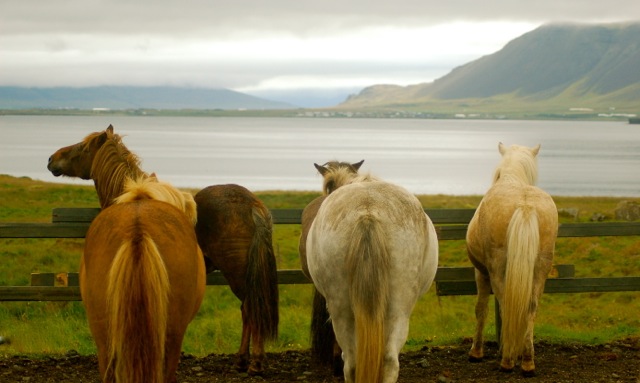
Icelandic PONIES

I’ve only just got it. Really, really got it. I’ve figured out that I travel for the interactions with others, the scenery really is just a set of backdrops. Iceland prompted this realisation. It’s a wet wee isle, entertaining scenery, but nothing hugely different to what I can see back home, at least in summer. And certainly not as dramatic as some of the visual splendour I travelled through in the US. But the people, the stories told by the people, the self-deprecation, the feisty humour. Smashing. A tour guide led a small group of us through Reykjavik the day we arrived. She told stories of christmas trolls, believing in elves enough to move motorways and the surprise election of the current mayor of the capital city (a stand up comedian). She lovingly took the piss out of her compatriots, and I knew I wasn’t in America anymore. This was an arts university graduate working for tips, and she was genuinely witty in her second or third language. Not even on brewery tours had anyone been this engaging in the States.

Elvish Tour Guide

I love that Iceland is so proud of their gene sharing with the Viking hordes. They quietly, almost reluctantly admit that their own Viking heroes were largely sheep farmers and horse breeders rather than raping, murdering pillagers. They sell Norse God action figures and install huge longboat sculptures on the foreshore, and their mythologies are woven into their lives. They seem a very self-assured people, fighting International conventions to ensure whale meat remains available in restaurants. I’m from a tiny island in the middle of nowhere too, but we have a nationally tendency to be somewhat apologetic about what others might see as our short comings. Icelanders have a depth of pride that maybe kiwis can learn from.

The Maori people back home have a strong mythologised culture too. Legends provide children with strong heroes, moral guidance and a sense of belonging.  I found that many Americans were ignorant of the tales of the Native American tribes, which is a great shame. I loved the myths of so many countries as a child, and I was proud that my country had our own. But lately in New Zealand general access to our mythic heritage may be under threat. The cultural icons of the Maori people are being assessed for copyrighting and trade marking. As a result I’m starting to lose confidence in my right to claim any degree of allegiance with what I see as my own cultural heritage, seemingly because I’m a whitey. Where in Iceland their stories and legends are a unifying point of cultural pride, I hope that in New Zealand they don’t end up contributing to divisions between people.

I didn’t have nearly enough days in Iceland, but at least my flight out was bound for another entertaining stop, London. Every time I accidentally on purpose end up in the shining jewel of the British empire something fun is kicking off. This time I did a search for “beer festivals” just a day or two before I flew out of Denver, and lo! The biggest beardy weirdy drinking convention in the British Isles was kicking off from the day I arrived. Yes please! London Olympia was lined with 800 beer, cider and perry (pear cider) taps, pork scratching vendors and bratwurst stands. The London Craft Beer Festival was having its debut outing the same weekend, but we decided to kick it old skool in hopes of avoiding over-hopped new world styles. We had no regrets as we sipped at creamy stouts and comfy brown ales. It was one of those events you wish you could teleport all your mates to. We shared a pint with one of the Scottish brewers, many of the smaller breweries had only one pint on tap (out of a total 800), and their alcohol architects were at hand to talk up their wares. The event was more about tasting than boozing, and there wasn’t a single screen showing football…Good on ya English beer brewing fellah’s and pickled fish vendors.

Beer fest

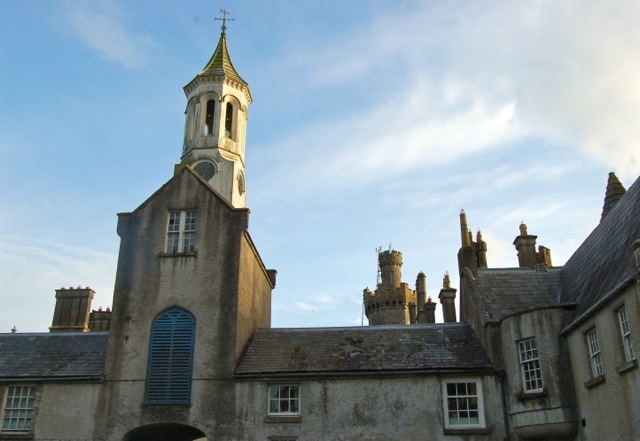
London was another briefish four-day interlude. Gatwick to Dublin is a quick hop, and then it was a skip to the bus lanes, and a jump to Castlepollard in Westmeath. I’ve been living in Castle Tullynally for a week now, helping with the gardening and tourist shepherding. I was shocked to find it only took 48 hours to get used to waking up and looking out the boudoir window to see white and grey towers and the arched gateway. I guess that’s a positive thing though, running a huge mansion looks like exhausting work, and the place probably costs even more than a two bedroom flat in Wellington. I’m enjoying being able to wander down to the vegetable gardens and harvest fresh beetroot for tonight’s chocolate cake though. And on the way back to the kitchen I pass donkeys, llamas and battlements, and I reflect on how fortunate I am to get to call another place home, even if briefly. I’ve always had mixed feelings about the Republic of Ireland, again it’s a people thing. It’ll be interesting to see how some time living with the locals shifts my perspective. And of course there’s some lovely scenery.

White tower

On the stories we create about ourselves

As we live life, we subconsciously construct a fairy tale about who we are. We take a few of the things we tell ourselves, a whole lot of things others tell us, and craft an incompetent portrayal  of ourselves. This then becomes an instruction manual for our future behaviour. It can affect almost every decision we make, from what flavour of Tim Tams we buy, to whether we have an affair with the butcher. We will seek out people who reinforce that belief, and most likely will be distrustful of those whose opinions don’t mirror our self assessment. These templates can be set at a young age, and may last, unaltered, until we are drooling down our flannelette nightshirts, propped against a radiator in a hospital corridor.

Ok, let’s personalise this. From a young age, maybe seven or eight, my story began to incorporate something like “Regan was born to be an artist…” Positive responses to my early drawings, enrolment in a specialist art course, and winning that skateboarding book, all contributed to my internal fable. This might seem innocuous, or even useful. But as I presumed this artistic competence was a natural ability, I didn’t push myself to extend my skills. Worse, I also began to excuse a range of my less positive behaviours, I just presumed they were part of my “artistic temperament”. My story shifted to something like “Regan is a great artist, a born talent, so he’s expected to rage against the slightest criticism, be spiteful of any form of conformity, and party today, for his great talent will no doubt be recognised tomorrow.” I’m awfully pleased I escaped my story with neither an addiction to opiates, nor a missing ear.

So how did I escape the bounds of my ridiculous tale? I believe it was the psychological equivalent of a solid hit to the head. Three years ago I was turned down for a position as a concept artist in the UK. My rejection note explained that they didn’t find my sketching advanced enough. Cue: huge sledgehammer hitting forehead. At first I argued with myself that they didn’t understand my style, that I hadn’t had enough time, that they hadn’t fully explained the brief. Cold hard facts were studiously ignored. How dare “they” confront me with something that conflicted with my self belief? But I was jarred, and forced to examine contradictory and heart breaking evidence. And in the end the only thing positive I could find in the broken fragments of my career as a painter, was an opportunity to edit my story. Haha, and somewhat ironically, that’s when I decided it was time to try and make a living through writing.

What would they know...
What would they know…

Some stories though, are much more harmful, and difficult to transcend, than mine. We can end up supporting a story of ourselves as worthless, or incapable of love, or undeserving of positive relationships. Abused women and children can convince themselves that they somehow deserve punishment, and long after they escape one brand of torment, they find themselves gravitating towards further victimisation. It’s those of us that end up trapped in stories like these, that need to understand what drives them to sabotage their choices. Recognition of our stories is the first step towards being able to affect them. And if we recognise this in others, we owe them assistance.

It’s not all gloom with a side-salad of doom though. Some of us are capable of subconsciously manipulating and changing our stories in order to improve our lives. A very good friend of mine had an extremely difficult time getting through her first degree. She attended lectures and tutorials, she studied, she understood what she was taught, but somehow when she wrote essays and dissertations, they didn’t reveal her depth of understanding. On preparing to face another bout of academia several years later, she was tested for learning disorders, and told that she was dyslexic. Now many people might see this as a grim setback, but such was her force of will, she managed to do the opposite. She researched the range of conditions clustered under this title, and determined that some of the greatest thinkers of the last couple of centuries had been posthumously diagnosed identically. And then she turned it into a super power. Rather than mask or hide her “difference”, she boasted of it. She told me she felt sorry for those mere mortals who functioned normally. This was astounding to watch happen. It took a few weeks to solidify, but once it did, none of my arguments (her statement that I was intellectually disadvantaged didn’t match my story, so argue I did…) affected her newly formed tale.

Not all of us are this resilient, but I think that if we can find ways to understand our stories, and how they affect our choices and behaviours, then we can gain power over them.

On the difficulties of trying to make money from drawing pictures…

I started off my artistic career drawing airports on cereal boxes, filling old phone books with animated sword fights, and making birthday cards illustrated with dragon-sharks. My first significant art win was at age nine. A class competition to do the best picture of Paddington Bear snagged me the unfathomable prize of a book on skateboarding. My skating never really took off, my mothers snapshot of me standing on my brothers board with a cushion belted to my arse attests to that. But the recognition for something which came so easily to me shifted my world. Two years later a classmate offered to buy my life-size painting of a Star Wars character from me. A liberal arts career was forecast.

Unfortunately I encountered an arts teacher soon after, who was to divert my creative career options. Mrs Manthell managed to put me off arts training for life. Freedom of subjectwas an alien idea for her, and her attempts to force students down narrow channels frustrated me. The top art prize that year went to a representation of a crisp packet. Andy Warhol’s influence on the Newlands College art curriculum forced me to conclude that I would have to teach myself. And without any significant honours in art subjects, I had little choice. Within three years art became a side project to my hormonal urges, and I seemed destined to produce intermittent album covers, band posters and tattoo designs.

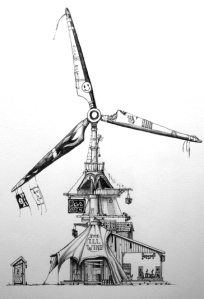
As I moved beyond university, and particularly as I began to travel, I became more interested in what was happening in the wider world. My ideas on how I might use my paintings changed dramatically. While I was still focussed on creating attractive images, stories of climate change, and a resurgence in Somalian led pirate attacks were what fired imagination. I spent three years attempting to promote my political ideologies through my artwork. I had the best of intentions, I wanted to inform and educate through my detailed, symbolic paintings. But I lost my audience. I found that though a picture might tell a thousand words, the words were different for every viewer. And somehow without a recognition of the underlying stories, my paintings didn’t work. And didn’t sell.

Turbine lightened

At this stage of my life I had yet to make any significant money from my arty farty endeavours. I’d taken on whatever job kept me fed and liquored, from catering weddings in Cambridge’s finest cafe (yay Michaelhouse!) to assisting with chainsaw sculpting in the North of England. My artwork was always to be my escape from mundane career options, and a crushing end to a potential career as a concept artist saw me facing a crisis of faith. A lifetime grafted to an office desk loomed. But my girlfriend at the time offered me fresh perspective, she (bless her) had enough belief in my creative goals to offer me redemption through another medium. She pointed out that my writing was my stronger voice, and that when I wasn’t waffling or ranting, it was a more effective way to deliver complex messages. An epiphany by proxy. Within hours I found a course on freelance writing with the London School of Journalism, dropped most of my savings on the first terms fees, and grinned as any hopes of a sensible lifestyle quickly receded.

I love meeting new people around the world, and learning from the stories they tell of their lives. I want to use these experiences to create imaginative and engaging fables. I’m not sure how this will earn me enough money to survive, but long ago I realised the importance of living with passion. I think that when we find something that fuels our enthusiasm for life, we owe it to our ourselves to engage with it. Even when it’s not the most stable or sensible option. A drinking companion once told me that the saddest three words in the English language are “I used to…”, accompanied by backwards glance at what might have been.