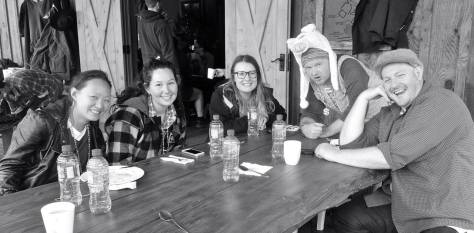
My age was a defining characteristic right from the start. Actually, probably before the start, measured really from the moment of conception. Once I was freed of the womb, it was a scale against which my progress was judged. “Oh, so he isn’t crawling yet? Never mind, maybe he can be a conservative.”
It soon became part of the way I defined myself. “My name is Regan, I can draw an airplane and tie my shoe laces and I am four-and-three-quarters”. It became a ranking system in social situations. The five-year-olds got the toy rifles, those under five made do with sticks or finger-pointing. Though I did learn to draw that Remington two-finger pretty damn quick.
It was age-division that was my first experience of segregation. Specifically the great adult-child divide. At celebrations us children got a lower table, fewer items of cutlery, and higher sugar-content foods. The adults had the taller tables, more complicated social rules, and decisions to make on who would have to drive. I also learnt that certain behaviour, activities and ideologies were restricted to each side. Alcohol, untruths and high-impact cursing were strictly for “the adults”. Imagination, playtime and brutal honesty were the domain of children.
And yet my memories of childhood are largely of sunlight and adventure. I didn’t undergo any of the maturity summoning transformations that some of my peers had to face. My parents never divorced, I didn’t have to raise my siblings, I was neither abused nor abandoned. I got to be a very thorough eight year old, building fortresses from cushions, mown-grass, and imagination. I was a competent ten-year old, earning my scars by playing games of “policemen versus protestors”, riding my BMX off cliffs, and hurling adult-branded curses at bullies. And I became well-versed in the dark arts of teenageism. Blushing around girls, arguing with Dad about the length of my hair, and replacing judicious portions of my parent’s darker spirits with tea.
When I look at a photo of myself on my 21st birthday, I realise that I largely matched society’s age-expectations. I had a peer-inherited (and media enhanced) disregard for authority. I had long hair, and a tattoo with an ungracious story. I left university classes early to play bass guitar in a metal band named Shocker. And I had a Rainman-like ability to calculate the best alcohol-by-volume-by-price in a bottle store. Yip, 94% age-appropriate.
Social pressure remained relentless, if not always overt. I understood that by the age of thirty I should have been married, with a house, and maybe a child on the way. I rebelled. It wasn’t until thirty-one I had a wife and a house. And horses. I had a good, steady job that paid well, but I’d demoted fantasy and imagination, replaced some of my dreams with wants. As a result there was a tension within me, a pull between society’s expectations, and my buried needs. At thirty-three, I imploded. House, home, relationship, job. I didn’t have the emotional maturity to deal with the aftermath. So I boarded a plane.
For the next few years I put myself in situations where I lived, worked and danced with people ten years younger than me. People who labelled their hopes as certainties rather than impracticalities. People who looked for their options on a wide horizon rather than down a narrow tunnel. Ok, some of them pissed in the laundry, shat in the shower or offered loud advice from places of ignorance. But by now I knew that age was no antidote to foolishness. I started to realise that elucidation had to be earned, not granted. So I paid attention to my surroundings.
One of the greatest things about immersing yourself in an unfamiliar community, is that you have a chance of developing empathy, appreciation, understanding. Ageing is an opportunity through which we can build comprehension through experience. What it is like to sit in your first maths lesson. What it means to be afraid of the dark. What it means to be struggling with teenage ideas around gender. Imagine what we might gain if had to live through a range of ethnicities? Or if over our lifetime we gradually shifted gender? What insights and understanding might we draw?
And yet such opportunities might well be squandered. At thirty I believed that the people I could best relate to, were those of my own age. I thought that we’d been born at the best possible time, and that we shared things no other age could understand. Hair metal, misogyny, The Goonies. Besides, society frowns at the idea of inter-age mingling. It represents it as insidious, or inappropriate, or sad. At thirty-three I began to undo my prejudice. As a consequence I spent the next ten years learning my most consequential lessons in humility, creativity, and the development of wisdom, from yoofs.
One of those world-shakers was my girlfriend for much of that time. She taught me the importance of honesty, and honour. Of forgiveness.The difference in our ages wasn’t a problem until a biological alarm shifted her world. Fortunately she’d also taught me enough about self-reflection to avoid immolation, and so I began hosting couch surfers in order to fill a number of voids. And I was surprised to find that one of the most spontaneous, creative and inspirational was a woman just a little older than me. She had endless stories, she’d made beer for years, and she lived in Boulder, Colorado. Like Mork and Mindy (kids my age will get it…). I booked another flight.
She introduced me to a range of wonderful people, people who at forty, or fifty, or sixty, who still had an eye on the horizon. People who didn’t let their age dictate who they should be. People who rather than giving up on their dreams, had chased them down, and then found new ones. And since then I keep finding older-aged heroes.
Ageism is a powerful prejudice, one which build barriers and promotes ignorance. Our societies should promote kinship, not division. And as with anything societal, it is up to me to be part of any change.
So I choose to see age as a choice, not a curse. I can choose to age poorly. Choose a diet designed to challenge my heart and bowels rather than befriend them. Choose to define functional alcoholism my pointing to the one gunt in the pub that’s more pished than I am. Choose to tell myself that a sore back, a beer belly, and a mutually damaging relationship with a girlfriend I’ve taught myself to hate, are all symptoms of too many years, rather than my own poor choices.
Or I can choose to learn every day, to rewrite my prejudices through experience. Choose to summon the vigour and hope of my teens and wrap this around the compassion and care I’ve taken on in my forties. Choose to measure people by the depth of their hugs, the warmth of their smile, and their capacity for enjoyment, rather than the country of their birth, the number of candles on their cake, or their possession (or lack of) a Y-chromosome.
I choose to make (as much as possible) my own choices.

 Inappropriate Footwear